

Cheltenham Festival 2027 — Early Data-Led Previews, Ante-Post Odds and Strategy
Why the 2027 Cheltenham Festival Demands Early Preparation
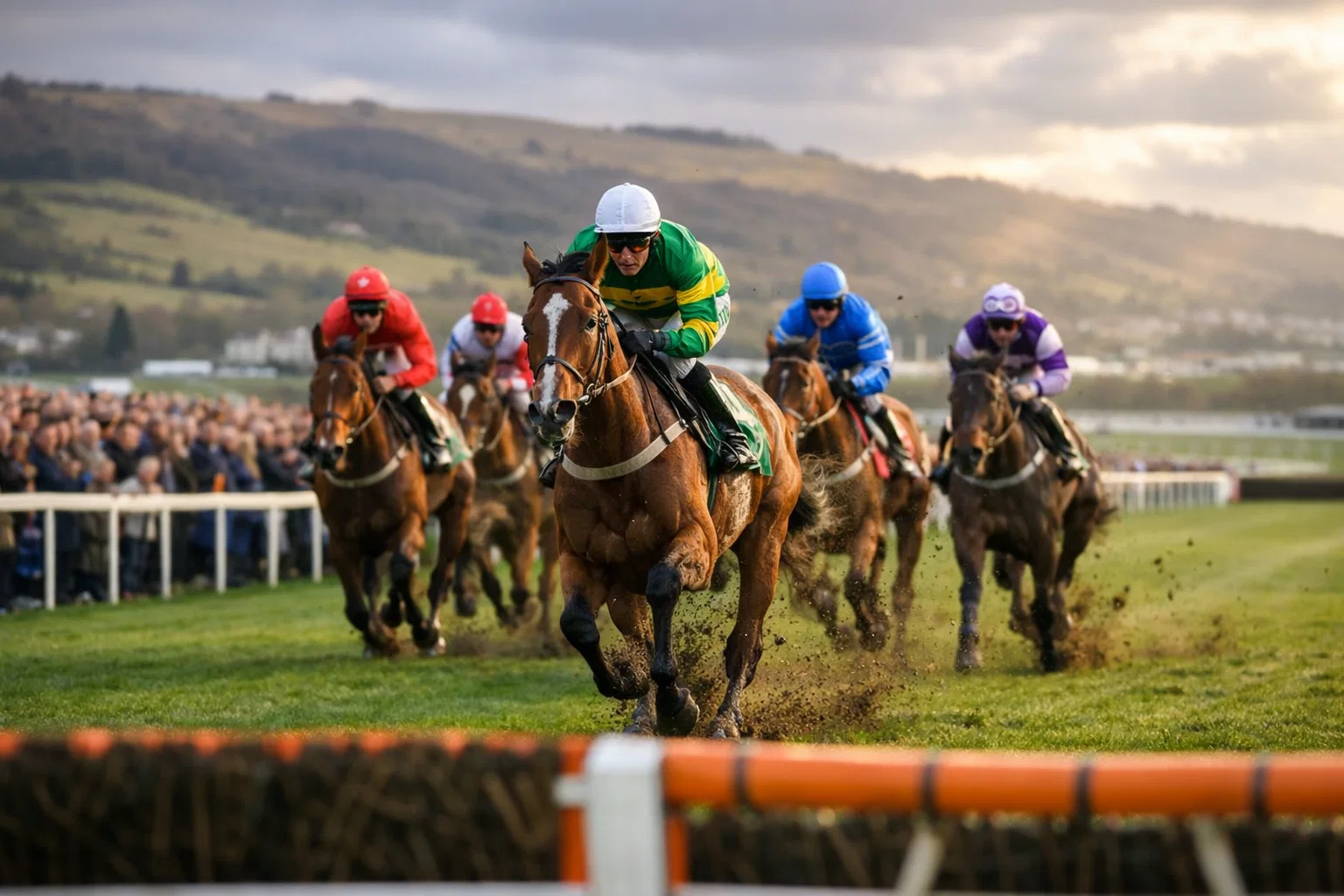
With the 2026 Cheltenham Festival now in the history books, attention turns to Prestbury Park and the 2027 renewal, scheduled for 10–13 March 2027. While final declarations are months away, the ante-post markets are already shaping up, and the record-breaking trends of 2026 — including a £4,975,000 total purse and a revised daily attendance cap of 66,000 — provide a compelling framework for early analysis.
For punters, the implications are straightforward. The deeper prize money seen in 2026 attracted stronger fields and reshaped form lines, and that trajectory is expected to continue into 2027. Meanwhile, the reduced capacity cap reflects a deliberate long-term strategy by The Jockey Club, which continues to nudge casual racegoers towards online and mobile betting — exactly where price comparison and data analysis matter most.
This guide is built for that environment. Whether you are scanning ante-post markets for the first time or refining your staking strategy months in advance, the structure here moves from early picks through odds mechanics, ground analysis, historical trends and bankroll strategy. Every section is grounded in verifiable data — because at a meeting where only around 29 per cent of favourites have won since the turn of the millennium, your edge starts with the data, not the hype.
What you will not find here is tipster theatre. No breathless NAPs fired from the hip, no "certainties" dressed up with exclamation marks. Cheltenham punishes lazy analysis more reliably than any other fixture in the National Hunt calendar. The goal of this page is not to eliminate uncertainty — it is to help you navigate it with sharper tools and cleaner information than most of the betting public will have to hand, well ahead of the 2027 Festival.
Jump racing at its highest level is a collision of preparation and chaos. The data tells you which side to lean towards. Let's get into it.
What the Data Says Before You Place a Single Bet on the 2027 Festival
- The 2026 festival set a new benchmark with a £4,975,000 purse and a 66,000 daily cap — expect similar or higher figures for 2027.
- Only 29.2 per cent of Cheltenham favourites have won since 2000; blind loyalty to market leaders is a losing strategy over four days.
- Irish-trained runners have taken 61.3 per cent of all Prestbury Cup races — factor that structural advantage into every Grade 1 assessment.
- Ground conditions shift throughout the day; check the GoingStick at 8am, 11am and pre-race before committing stakes.
- Divide your bankroll into 20-25 units, compare prices across at least three bookmakers, and use Best Odds Guaranteed wherever available.
Early Ante-Post Picks: Where the Data Points for March 2027
The 2027 Cheltenham card will feature 28 races across four days, and while final declarations are months away, the ante-post markets already offer clues. Rather than spraying selections at random, the approach here filters every potential contender through three lenses: recent form on comparable ground, trainer intent at the festival, and whether the market price reflects genuine probability or public sentiment. When those three filters align on a horse, you have a pick worth backing. When they conflict, you have a race worth watching — and probably leaving alone.
Selection philosophy: Every pick below has passed at least two of the three filters based on 2026 data and early 2027 entries. Where only one filter applies, the horse is flagged as a danger rather than a selection. The aim is disciplined wagering across the card, not action on every race.
Early Look: Supreme Novices' Hurdle
The Supreme is traditionally the most volatile opener of the festival. Large fields of unexposed novices collide with the unique atmospheric pressure of the Cheltenham roar, and form from Leopardstown or Kempton does not always translate. The key data point here is trainer record: Willie Mullins has dominated the novice hurdle division for the better part of a decade, and when he targets a horse specifically at the Supreme rather than splitting entries, that focus tends to pay off. Watch for Mullins runners near the head of the ante-post market. If the horse has won on ground softer than good and has shown pace from the front two out, that profile fits the Supreme historically better than deep closers who rely on a muddling pace.
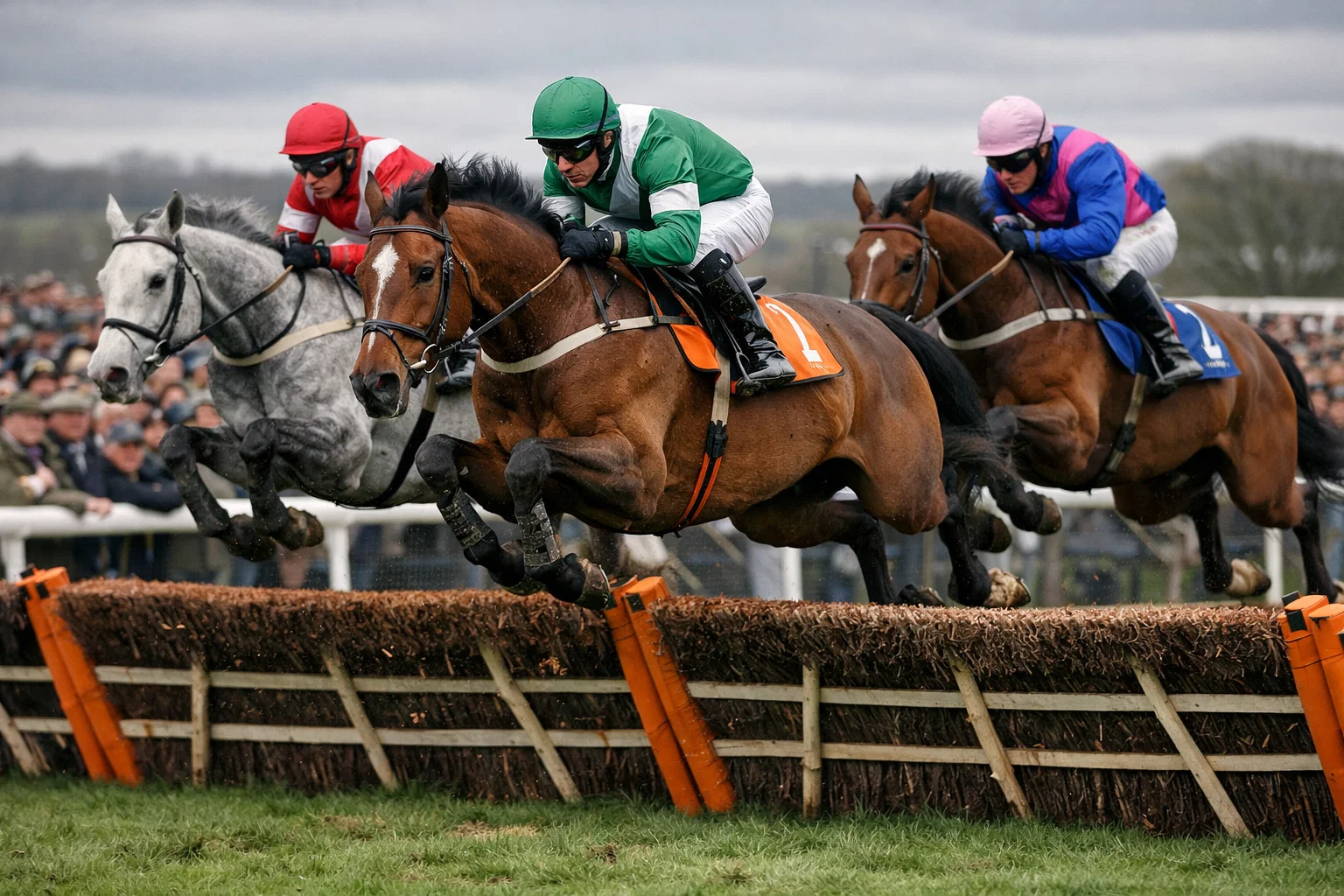
The danger is usually a British-trained novice with a big engine and a high cruising speed — the sort of horse that benefits from the downhill run to the second-last. Check for a Nicky Henderson or Dan Skelton runner priced between 5/1 and 10/1 with at least two wins from three starts this season.
Feature Handicap: Early Assessment
Handicaps at the festival demand a different approach entirely. The form book is thicker, the weights are assigned by the official handicapper rather than by market consensus, and the best value frequently lies with horses who are improving faster than their rating suggests. The metric to watch is the gap between a horse's Racing Post Rating and its official BHA mark. A horse rated 145 by Racing Post but running off a mark of 138 has seven pounds of "hidden" ability — and in a 20-runner handicap, that gap can be the difference between 14/1 and a genuine each-way contender.
In the 2027 feature handicaps, pay attention to lightly raced types with no more than six or seven starts over hurdles. These horses have the least exposed profiles and therefore the most room for the handicapper to have underestimated them. Cross-reference with ground preference: if the GoingStick reading holds at 6.2 or dips below, prioritise horses whose best runs came on soft or yielding ground.
Championship Races: Reading Intent
Championship races — the Grade 1 contests that anchor each day — are decided as much by jockey booking and stable confidence as by raw ability. When a leading stable runs three entries but its number-one jockey commits to one specific horse days before the race, that is a signal. The market usually responds to these declarations, but not always efficiently. Watch for situations where the declared favourite has drifted slightly from its morning price despite no negative news — that drift often reflects casual money shifting elsewhere, not informed opinion.
Championship race filter: Since 2000, horses sent off at odds between 2/1 and 4/1 in Grade 1 races at the festival have a strike rate of roughly one in three. That is lower than most punters assume — and it means the second or third favourite frequently offers better expected value than the market leader.
British trainers are increasingly candid about the competitive landscape. Irish-trained runners deserve respect in every championship race, but British stables are not turning up to make up the numbers. When a Skelton or Henderson runner is priced at 6/1 or bigger in a race dominated by Irish entries in the betting, the market may be undervaluing home advantage on familiar ground.
The Later Card: Discipline and Patience
By mid-afternoon, the temptation to chase losses or press an advantage intensifies. The final two races on the card are typically lower-grade affairs — national hunt flat races or novice handicaps — where form is thin and volatility is high. If the earlier picks have landed, there is no shame in banking profit. If they have not, a speculative wager on a 20/1 shot in the bumper is entertainment, not strategy.
For those who want an opinion in the closer, revert to the trainer filter. Bumpers at the festival are disproportionately won by stables that target this race type deliberately. Mullins runners in bumpers carry an unusually high strike rate relative to their market price. The key is small stakes and low expectations — treat these races as bonus opportunities, not the centrepiece of the day.
Picks are only as good as the price you take. The next section breaks down where to find the best odds across bookmakers — and why the difference between 5/1 and 11/2 on the same horse can reshape your entire day.
Ante-Post Odds Snapshot: Finding Value Ahead of March 2027
The difference between a good bet and a great one often comes down to the price you accept. At a meeting like Cheltenham, where fields are large and markets liquid, the same horse can be priced at 7/1 with one bookmaker and 15/2 with another. On a £20 stake, that gap is worth £10 in pure profit if the horse wins. Multiply that across seven races a day over four days, and price comparison stops being a nice-to-have and becomes the single highest-impact habit a punter can develop — especially in the ante-post market.
| Race | Selection | Bookmaker A | Bookmaker B | Bookmaker C | Best Price |
|---|---|---|---|---|---|
| Supreme Novices' Hurdle | Market Leader | 5/2 | 11/4 | 5/2 | 11/4 |
| Feature Handicap | Value Pick | 10/1 | 11/1 | 10/1 | 11/1 |
| Championship Race | Form Pick | 7/2 | 4/1 | 7/2 | 4/1 |
The table above is illustrative, but the principle holds across every card. Bookmakers set their tissue prices independently, adjust margins differently and respond to money at varying speeds. Early in the ante-post market — typically weeks before the festival — the variation tends to be widest, which is why serious punters take their prices early when they have a strong opinion. By the time the race is thirty minutes away, the overround has tightened and the differences narrow — though they never disappear entirely.

Best Odds Guaranteed — commonly shortened to BOG — is the mechanism that protects punters who take an early price. If you back a horse at 8/1 in the morning and the Starting Price drifts to 10/1, a bookmaker offering BOG will pay you at the higher price. It is, in effect, a free option: you lock in a floor price and benefit if the market moves in your favour. Not all bookmakers extend BOG to every race at Cheltenham, and some restrict it to specific bet types or maximum stakes. Always check the terms before assuming you are covered.
Place terms are the other variable that most casual punters overlook. In handicap races with sixteen or more runners, some firms pay four places at one-fifth the odds while others pay five places at the same fraction. In a competitive Cheltenham handicap with 20-plus runners, that fifth place can be the difference between a losing each-way bet and a small return that keeps your bankroll intact.
A practical approach: open accounts with at least three operators before the festival, verify your identity in advance, and use an odds comparison tool to check prices before every bet. The thirty seconds it takes to compare pays for itself more often than any tipster subscription.
Understanding the prices is one thing — knowing what those races are worth is another. The schedule below maps the classic festival card, though 2027 timings are yet to be confirmed.
2027 Race Schedule: What We Know So Far
The full race schedule and prize-money breakdown for the 2027 Cheltenham Festival has not yet been officially released by The Jockey Club. Historically, the festival features 28 races over four days, with Grade 1 championship races — the Champion Hurdle, the Queen Mother Champion Chase, the Stayers' Hurdle and the Cheltenham Gold Cup — anchoring the card.
Based on the 2026 structure — which distributed a record £4,975,000 purse — we expect a similar format for 2027, with the Gold Cup remaining the showpiece event carrying the largest prize fund. The official schedule is typically announced in the autumn preceding the festival. Bookmark this page and check back for updates as the 2027 fixture list is confirmed.
2026 schedule for reference (subject to change for 2027): The 2026 card included the Sky Bet Supreme Novices' Hurdle (1:20), the Arkle Challenge Trophy (2:00), the Fred Winter Juvenile Handicap Hurdle (2:40), the Ultima Handicap Chase (3:20), the Champion Hurdle (4:00), the Plate Handicap Chase (4:40) and the National Hunt Novices' Handicap Chase (5:20) on Day One. The 2027 schedule will be published as soon as it is made available.
From a betting perspective, the schedule matters for pacing. If you plan to bet on five of the seven races, you need your bankroll divided and your selections confirmed before the first race. There is barely forty minutes between contests, which leaves no time for research between races. Do the work now. The card rewards preparation, not improvisation.
Going Report: How Ground Conditions Reshape the Betting at Cheltenham
Ground conditions at Cheltenham are not background noise — they are the single most underestimated variable in festival betting. A shift from Good to Soft can flip the form book on a dozen races in an afternoon, turning a 3/1 favourite into a vulnerable proposition and promoting a 14/1 shot with a proven record on testing ground. Getting the going right is not optional; it is foundational.
GoingStick explained: Cheltenham uses the GoingStick penetrometer to measure ground conditions on a scale from 1 (heavy) to 15 (hard). A reading of 6.2 corresponds to Good to Soft, Good in places under the Racing Post going model. That number is taken at multiple points across the track — the centre of the course, the inside rail and the stands side — because drainage varies significantly between areas. The New Course, used on Days One and Four, tends to ride slightly faster than the Old Course due to its wider galloping layout and better natural drainage.
The official going description on the morning of racing is not the whole story. A horse drawn wide on the New Course may encounter slightly different ground to one hugging the inside rail, and horses that race prominently — up with the pace rather than held up at the back — tend to encounter fresher, less churned-up ground in the later races of the day. By the sixth or seventh race, the area approaching the final flight or fence can become significantly more testing than the official going would suggest.
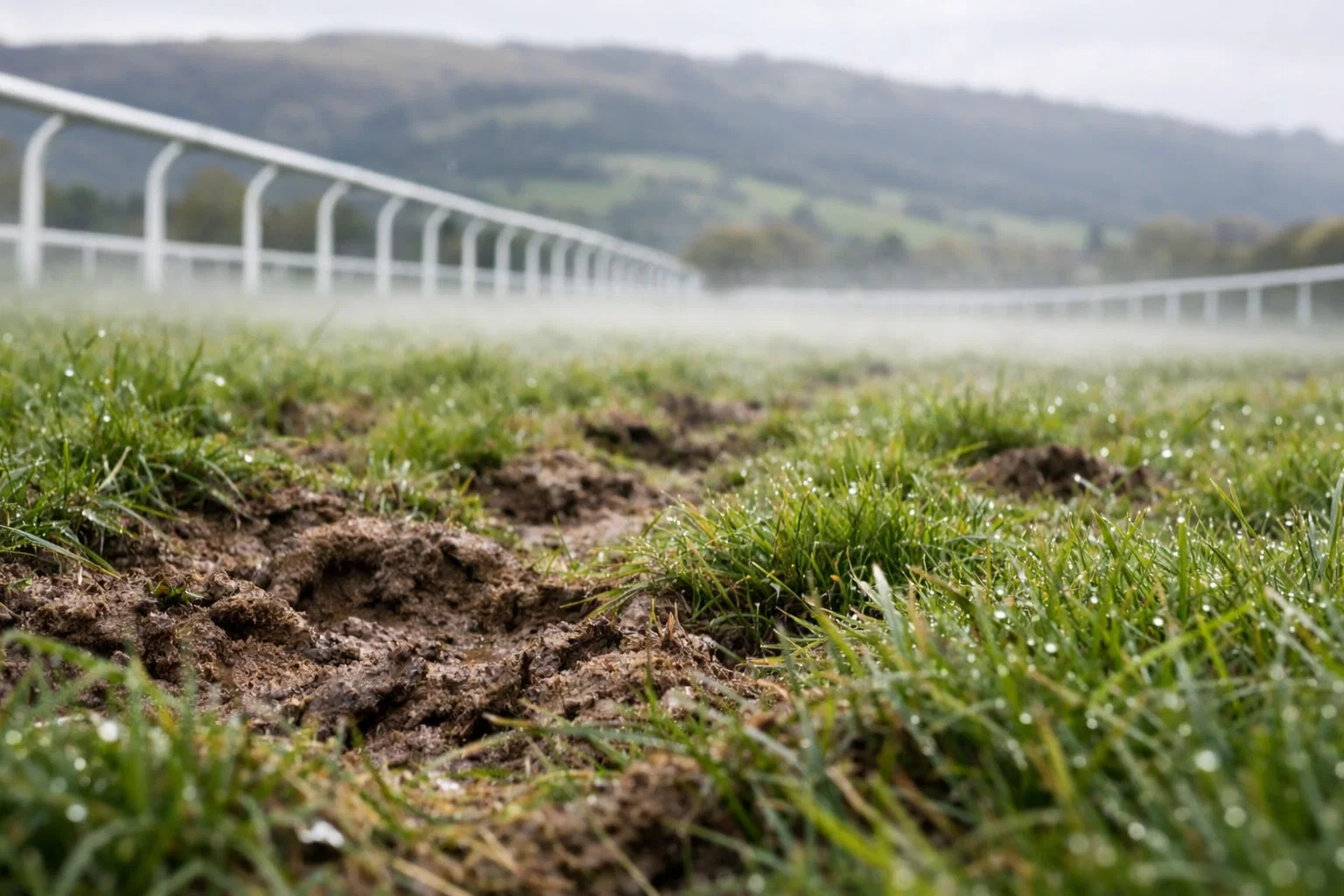
The broader context matters too. According to the BHA Racing Report for the first half of 2024, 71 per cent of all Jump races in Britain between January and April took place on soft or heavy ground — compared with 39 per cent in 2023 and 36 per cent in 2022. That trend means the current generation of National Hunt horses has more soft-ground experience than its predecessors, which compresses the advantage that "soft-ground specialists" once held. When almost every horse in a field has raced on soft ground recently, the differentiator is how efficiently a horse travels on that surface and whether its jumping holds up when the ground takes away a length at every obstacle.
Check the going report at 8am, again at 11am after any overnight watering decisions are confirmed, and once more in the hour before racing begins. If the going has shifted since you placed an ante-post bet, reassess the race rather than clinging to a position based on stale assumptions. Ground does not care about your confidence level — it simply changes the race.
Reading the Form: Age, Fitness and Course History
Form analysis at Cheltenham is not about finding the horse with the most wins this season. It is about identifying the horse whose profile — age, ground preference, course experience, fitness curve — best matches the demands of the specific race on the specific day. The festival is a different beast from a Tuesday at Wetherby, and the data shows it.
Age matters more than you think. Seven-year-old horses that have previously won at the festival post a strike rate of 28 per cent since 2013. That is a genuinely useful filter. Meanwhile, horses that are five or more years older than the youngest runner in their race have managed just 14 wins from 264 attempts since 2003 — a strike rate so low that it should serve as a red flag rather than a selection criterion.
Why does age profile matter so heavily at this particular meeting? Cheltenham's undulating track, with its famous uphill finish, punishes older legs disproportionately. The climb from the final fence to the winning post is 165 yards on a demanding gradient. Younger horses in their prime — typically aged six to eight — handle that climb with more energy in reserve. Older campaigners, even those with superior form on flat tracks, can find the hill exposes a physical ceiling that does not appear on the form page.
Course form is another filter worth applying, but with a caveat. A horse that has won at Cheltenham previously clearly handles the track's unique demands. However, the most recent course run matters far more than one from three seasons ago. Horses evolve: they change physically, they develop preferences, they encounter different ground. A horse that won at the November Meeting on Good ground is not guaranteed to replicate that form in March on Soft. Use course form as a positive indicator, not as a guarantee.
Fitness is the third pillar. Cheltenham sits in mid-March, which means some horses are peaking at the right moment while others have already had their best run of the season in January or February. Look at the spacing between a horse's last three runs. A pattern of roughly four to five weeks between outings, with the most recent run showing a competitive finish at a strong track, is the ideal preparation profile. Horses returning from a break of eight weeks or more are an immediate query — not because they cannot win, but because sharpness over obstacles is difficult to maintain without race practice.
Combine these three filters — age profile, course history and fitness timing — and you can eliminate a significant percentage of the field before looking at the betting market. The survivors are your shortlist. The market price tells you which are undervalued.
Trainers and Jockeys: Who Controls the Festival
If Cheltenham were a football league, one club would have won the title every year for the past decade and nobody would be allowed to talk about salary caps. Willie Mullins' record at the festival stands at 113 winners, making him the leading trainer twelve times over — including a joint-record ten winners at the 2025 edition alone. Those are not just impressive figures; they are structurally important for any punter trying to price up a race. When Mullins declares a runner in a Grade 1, the market adjusts, the form analysts pivot, and the competition recalibrates.
"It has been a fantastic week. Anytime you have a winner at Cheltenham it is good, but to have more than one is brilliant. No one would ever have dreamt someone would have that many horses to run at a Festival like this, but it's something we concentrate on and it's paying off for us." — Willie Mullins, Leading Trainer, Closutton Stables. That combination of ambition and systematic focus is precisely why Mullins-trained runners consistently outperform their market odds across the four days.
Jockey lens: Paul Townend, Mullins' stable jockey, has ridden 34 festival winners over the past decade and carries a level-stakes profit of +12.53 points. That profit figure is perhaps more telling than the raw win tally — it means that blindly backing every Townend ride at the starting price would have returned a healthy surplus. Very few jockeys at any level of racing can claim a positive LSP figure over a ten-year sample.
The historical record holder among jockeys remains Ruby Walsh, whose 59 festival victories set a benchmark that Townend is steadily chasing. Walsh's ability to read Cheltenham races from the front redefined how tactical riding at the festival was perceived. Townend rides with a different rhythm, preferring to settle horses and deliver them late, but the Mullins machine accommodates both approaches.
On the British side, the picture is more fragmented. Nicky Henderson and Dan Skelton are the leading forces, but their combined output at recent festivals has not consistently matched the Irish numbers. The Prestbury Cup — the informal scoreboard tracking wins by Irish-trained versus British-trained runners — has not been won by Britain since 2015, with Ireland dominant every year bar a draw in 2019. In 2025, the margin was a crushing 20-8 in Ireland's favour, according to ESPN's tracking. Over the twelve editions of the Prestbury Cup, Irish trainers have accumulated 204 victories from 333 races, a 61 per cent share that reflects a structural advantage in recruitment, point-to-point pipelines and sheer investment depth.
"I've thought about it because I'm a competitive bugger but the reality is Willie will be leading trainer. With a bit of luck, we might be pitching behind him along with a few others." — Dan Skelton, Leading British Trainer, Lodge Hill. Skelton's honesty is refreshing and tactically useful. When the leading British trainer openly concedes the trainer championship, punters should price that information into their calculations: Irish-trained runners in Grade 1 races are not speculative picks; they are structural favourites.
That said, British trainers have pockets of excellence. Henderson's record in novice hurdles, Skelton's improving record in handicap chases, and Jonjo O'Neill's familiarity with every inch of the Prestbury Park turf should not be dismissed. The edge for punters lies in knowing which specific race types suit which trainers — and not assuming that Ireland's dominance extends uniformly across every contest on the card.
Betting Strategy: Bankroll, Timing and Market Awareness
The Cheltenham Festival is four days, 28 races and — if William Hill's projection holds — approximately £450 million in total wagers placed across Britain. That volume creates liquid markets, which is good news for punters looking for value. But liquidity also means that the market is generally efficient: genuinely mispriced horses at Cheltenham are rarer than at a midweek card at Plumpton. Strategy, then, is not about finding hidden gems nobody has considered. It is about executing a disciplined plan when the rest of the public is throwing darts.
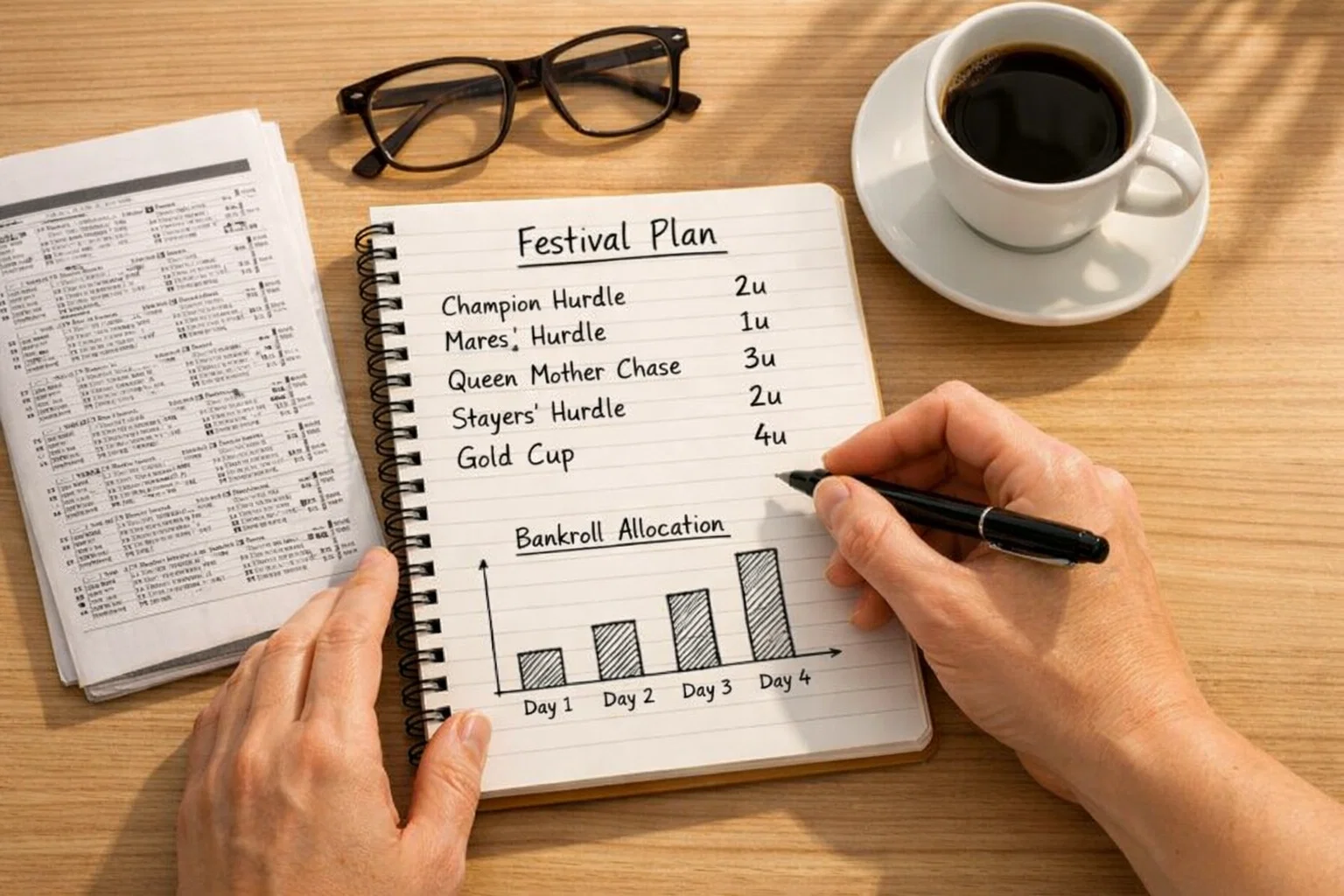
Start with a bankroll. Decide before the festival opens how much money you are prepared to risk across all four days, and accept that this amount could go to zero. A common framework is to divide the festival bankroll into 20 to 25 units, giving you the flexibility to place five or six bets per day without overcommitting on any single race. If a single bet represents more than ten per cent of your total festival bankroll, you are exposed to ruin faster than the data supports.
Timing matters. Cheltenham betting operates across three distinct windows: ante-post (weeks or months before the festival), week-of (Monday declarations through to morning prices), and day-of (from 10am to the off). Ante-post prices are typically the widest, reflecting the uncertainty of non-runners, going changes and last-minute stable switches. The reward for accepting that risk is a significantly better price. Several horses that were 16/1 ante-post three weeks ago are now trading at 8/1 following positive trial runs in the spring programme.
Since 2000, only 29.2 per cent of festival races have been won by the starting favourite. In 2025, the figure was nine winners from 28 races — a 32.1 per cent strike rate, marginally below the five-year rolling average of 35.5 per cent. Even the best year for favourites — 2022, when 12 of 28 won for a 42.9 per cent strike rate — still meant that more than half the market leaders were beaten. Those numbers should recalibrate how much faith you place in the market leader. Backing every favourite at Cheltenham is a reliable route to losing money over the long run. The better approach is selective: back a favourite only when the form, ground and trainer data independently support the market assessment. When they do not, look elsewhere.
The festival punishes overconfidence and rewards patience. The most profitable approach is to bet selectively — three or four strong opinions per day rather than a bet on every race — and to take the best available price at the moment of conviction, not at the moment of convenience.
Market awareness is the final layer. Odds do not just reflect probability; they reflect money flow. A horse that shortens sharply from 10/1 to 6/1 overnight may be doing so because informed money has arrived — stable staff, work riders, or connections who know the horse has worked well. Alternatively, the move may be driven by public hype on social media, which is uninformed and self-reinforcing. Distinguishing between the two requires watching the speed and source of the move. Sharp early-morning money from a single bookmaker is more significant than a gradual drift across all firms driven by tipster newsletters. The UK's betting industry generated £766.7 million in online horse racing gross gaming yield in the financial year to March 2025 — even as total betting turnover on British racing fell 6.8 per cent year-on-year in 2024, partly driven by the continuing impact of affordability checks. The sheer volume of money moving through Cheltenham markets means that inefficiencies, when they appear, tend to correct quickly. Move fast, or move on.
How to Place Your First Cheltenham Bet
If this is your first time betting on the Cheltenham Festival, the process is simpler than the jargon suggests. The basic mechanics are identical across every licensed bookmaker in the UK, and you can go from zero to placing a bet in under ten minutes. Here is how it works, step by step.
What you need: A valid UK bank card or e-wallet, a form of photo identification (passport or driving licence) for verification, and an email address. Most bookmakers also require age and identity verification before you can withdraw winnings, so completing this step upfront saves frustration later.
First, choose a bookmaker. Open an account by entering your name, date of birth, address and contact details. UK-licensed bookmakers are regulated by the Gambling Commission and are required to verify your identity and age before allowing you to place bets. This is not optional — it is a legal requirement, and any operator that does not ask for verification is one to avoid.
Second, deposit funds. The minimum deposit is typically £5 to £10 depending on the operator. Bank transfers, debit cards and e-wallets like PayPal are the standard options. Credit card gambling has been prohibited in the UK since April 2020, so do not expect to use a credit card for deposits.
Third, navigate to the Cheltenham Festival section. During festival week, every major bookmaker promotes Cheltenham on its homepage. Find the race you want to bet on, select your horse, and your bet will appear in the bet slip. Type in how much you want to wager, review the potential return, and confirm.
Fourth, understand the bet types. The simplest bet is a win single: you pick one horse, and if it wins, you collect. An each-way bet is two bets in one — one on the horse to win, one on it to finish in the places (typically first, second, third, or fourth in large fields). Your total stake for an each-way bet is double the unit: a £5 each-way bet costs £10. The place part pays out at a fraction of the win odds, usually one-quarter or one-fifth depending on the bookmaker and the number of runners.
Fifth, watch the race — or do not. Your bet is locked in once confirmed. Any winnings are credited within minutes of the official result. If you have completed verification, you can withdraw to the same method you used to deposit.
One final note for beginners: set a deposit limit before you start. Every UK-licensed bookmaker is legally required to offer deposit limit tools. Use them. The festival is more enjoyable when the money you are risking is money you have already decided you can afford to lose.
Bet Types at Cheltenham: Each Way, Accumulators and Beyond
Cheltenham's race programme supports a wider range of bet types than most casual punters realise. Knowing which structure fits which situation can materially improve your expected return — or, at minimum, prevent you from accidentally doubling your stake when you meant to place a simple single.
Win single: The most straightforward bet. Pick a horse, pick a stake. If the horse wins, you collect the odds multiplied by your stake plus your stake back. If it loses, you lose the stake. Clean, simple, and the foundation of all other bet types.
Each-way betting is arguably the most important weapon in a Cheltenham punter's armoury. An each-way bet is two separate bets: one on the horse to win, and one on it to finish in the designated places. At the festival, place terms for most races are one-quarter the odds for three or four places, depending on the number of runners and the bookmaker's terms. In handicap races with large fields — the Coral Cup, County Hurdle or Martin Pipe — some bookmakers pay out on five or even six places, which dramatically increases the probability of a return. Each-way betting shines at Cheltenham because the fields are large and the form is volatile. A 16/1 shot that finishes third in a 24-runner handicap returns a healthy place dividend even if it never threatened to win.
Accumulators — commonly called accas — combine multiple selections into a single bet. All selections must win for the bet to pay out, and the odds compound with each additional leg. A four-fold accumulator on four 3/1 shots produces a combined return of 255/1 — which is why accas are so popular and so rarely successful. At Cheltenham specifically, the volatility of results makes accas a high-risk entertainment bet rather than a serious strategy. If you insist on building one, limit it to three or four legs and use it alongside your main selections rather than instead of them.
Lucky 15 bets offer a safety net for those who want the accumulator thrill without the all-or-nothing outcome. A Lucky 15 covers four selections across 15 bets: four singles, six doubles, four trebles and one four-fold. If even one selection wins, you receive a return. Some bookmakers offer consolation bonuses — typically doubling the odds on a single winner. The cost is fifteen times your unit stake, but the structure provides multiple paths to profit.
The Placepot is a Tote pool bet requiring you to pick a horse to place in each of the first six races. Placepots at Cheltenham regularly produce substantial payouts due to the difficulty of navigating six consecutive races. The Yankee — 11 bets across four selections — sits between the Lucky 15 and the accumulator, omitting the four singles but retaining all combination bets.
For most festival bettors, a combination of win singles on strong selections and each-way bets on longer-priced horses in handicaps is the most practical approach. Use exotic bet types sparingly, understand the total stake before you confirm, and remember that complexity does not equal value.
Festival by the Numbers: 25 Years of Cheltenham Data
Numbers are only useful when they tell a story, and Cheltenham's data archive tells several — about the changing shape of the audience, the shifting balance of power between nations, and the economic engine that the festival has become. Here are the figures that matter, drawn from primary sources and set in context.
Attendance: A Complicated Trend
The 2025 Cheltenham Festival attracted 218,839 spectators over four days — the lowest total in a decade. That figure represents a significant decline from the all-time record of 280,627 set in 2022, when the post-pandemic rush delivered a 22 per cent drop to the 2025 number. The Wednesday of the 2025 festival was particularly quiet, drawing just 41,949 — the lowest single-day attendance since 1993.
The new daily cap of 66,000 for 2026 sets a theoretical maximum of 264,000 over four days, still short of the 2022 peak. The Jockey Club's decision reflects a priority shift towards experience quality — fewer bodies, better sightlines, shorter queues.
Economic Footprint
Cheltenham's impact on the local economy is substantial and well-documented. A study by the University of Gloucestershire, commissioned by The Jockey Club, estimated the 2022 festival's total economic contribution at £274 million — nearly three times the £100 million figure from the same study's 2016 baseline. Average per-visitor spending rose from £584 in 2016 to £697 in 2022, reflecting both inflation and the growing hospitality spend that now surrounds the racing.
"We welcomed a record crowd of 280,627 over the four days of The Festival in 2022 and it is fascinating to see the immense economic impact that the event has on the local area." — Ian Renton, Regional Managing Director (West Region), The Jockey Club. Those numbers place Cheltenham alongside the Open Championship and the Six Nations as one of the biggest single-event economic drivers on the British sporting calendar.
Interactive Tool
Visitor Spending Rise, and 2021 Overperformance Gap
Calculate the exact percentage rise in per-visitor spending, and quantify how far Irish win share outstripped runner share in 2021.
Percentage Increase
-
-
2016 Spend
-
2022 Spend
-
Absolute Rise
-
What this guide gives as two figures without the gap: "Average per-visitor spending rose from £584 in 2016 to £697 in 2022." The percentage increase is never calculated — it's +19.3%, a rise of £113 per visitor.
Overperformance Gap
-
-
Win Share
-
Runner Share
-
Multiple
-
What this guide gives as two figures side by side: "Irish-trained runners won 82 per cent of the races that year despite representing only 40 per cent of the total runners." The gap itself is never stated — it's 42 percentage points, meaning Irish runners won at 2.05x their representation rate.
Industry context: British horse racing as a whole generates over £1.47 billion in direct revenues, contributes an estimated £4.1 billion to the national economy annually, and supports approximately 85,000 jobs — making it the second-largest spectator sport in the UK after football.
The Prestbury Cup: Ireland's Grip
The Prestbury Cup tracks wins by Irish-trained horses against British-trained horses across the 28 festival races. Britain has not won the Cup since 2015, with Ireland dominant ever since — the only interruption being a draw in 2019. The 2025 scoreline of 20-8 was among the most lopsided results in the competition's history, and the cumulative record across twelve editions shows Irish trainers winning 204 of 333 races — a 61.3 per cent share.
The 2021 festival was the peak of Irish dominance: Irish-trained runners won 82 per cent of the races that year despite representing only 40 per cent of the total runners. By 2024, the ratio had eased slightly, with Irish trainers taking 18 of 27 races and 12 of 14 Grade 1 contests.
The Prestbury Cup is named after the village of Prestbury, near which Cheltenham racecourse sits. Despite the quintessentially English name, the trophy has spent the majority of its existence on the west side of the Irish Sea.
For bettors, the Prestbury Cup data is not just trivia — it is actionable intelligence. In races where the market is closely contested between an Irish-trained runner and a British-trained one of similar ability, the aggregate data suggests a structural lean towards the Irish horse. That does not mean every Irish runner wins; it means the default assumption should favour the training operation that has consistently demonstrated superior festival preparation. As BHA Chief Executive Julie Harrington acknowledged: "The rate of decline of jump racing in Britain at the top end has outstripped the measures that have been put in place to tackle it." — Julie Harrington, CEO, British Horseracing Authority. That admission from the sport's governing body underlines the structural depth of the gap that bettors should factor into every cross-channel form assessment.
Keeping It Enjoyable: Responsible Betting at the Festival
Set your limits before the festival starts. Every UK-licensed bookmaker is required by the Gambling Commission to offer deposit limits, loss limits and session time reminders. These tools exist for a reason — use them. It is far easier to set a £200 festival budget on Monday morning than to recalibrate your spending after two losing days.
The Cheltenham Festival is designed to be exciting. Four days of elite jump racing, large crowds, and the amplified emotional swings of live sport create an environment where the temptation to chase losses or increase stakes after a winner is higher than at any other point in the racing year. Recognising that environment is the first step to navigating it responsibly.
Practical measures that work: decide your total festival budget in advance and stick to it. Divide that budget by day and by number of intended bets. If you lose your Tuesday allocation by the third race, stop betting for the day — the card will still be there tomorrow. If you win, resist the urge to reinvest all profits into the afternoon races. Banking a portion of any winnings ensures that a good day does not reverse into a losing one through overconfidence.
Self-exclusion tools are available through GAMSTOP, which allows you to exclude from all UK-licensed gambling sites for six months, one year or five years. Cooling-off periods of 24 hours or seven days are offered by most operators and can be activated instantly. If at any point during the festival your betting stops being enjoyable, these tools provide a genuine safety net.
The festival is better when the stakes are affordable and the outcomes — win or lose — do not affect your financial wellbeing. Bet with your head, not over it.
Common Questions About Cheltenham Betting
What is the best type of bet for a Cheltenham beginner?
For a first-time Cheltenham bettor, each-way singles are the most practical starting point. An each-way bet covers both the win and the place, meaning you collect a return even if your horse finishes second, third or fourth. Choose races with large fields — handicaps with 16 or more runners — where place terms are most generous, and keep stakes modest. A £5 each-way bet on a 12/1 shot returns £20 or more if the horse places, keeping your bankroll alive without requiring a winner. Avoid accumulators until you understand how individual race dynamics work at a meeting where two out of every three favourites lose.
How do I check the going at Cheltenham on race day?
The official going report is published by Cheltenham Racecourse and updated multiple times on the morning of racing. You can find it on the racecourse's own website, on Racing Post, and through most bookmaker apps which display going information alongside the racecard. The report includes the GoingStick reading — a numerical measurement taken by a penetrometer at several points across the track — as well as a verbal description such as "Good to Soft, Good in places." Check the going at three points during the morning: first thing when the overnight report is published (usually around 8am), again at approximately 11am after any watering or rolling decisions have been confirmed, and finally in the hour before the first race, when the Clerk of the Course may issue a revised description based on race-morning conditions. If the going changes significantly from the description you based your selections on, reassess before committing further stakes.
Why do Irish-trained horses win so often at Cheltenham?
Irish dominance at Cheltenham stems from a structural advantage in recruitment, training infrastructure and festival-specific preparation. Ireland's point-to-point system produces talented young horses targeted at Cheltenham from the moment they enter training. Leading operations — particularly Willie Mullins' Closutton stable — campaign their best horses through a route of Irish graded races that peaks in March. The purchasing power of major Irish syndicates has outstripped British counterparts, meaning the best young horses from France and UK store sales frequently end up in Irish yards. The Prestbury Cup confirms it: across its twelve editions, Irish trainers have won over 61 per cent of festival races. The BHA has acknowledged the gap and is investing to strengthen domestic jump racing, but the effects will take years to materialise at Cheltenham.
