
 Available in US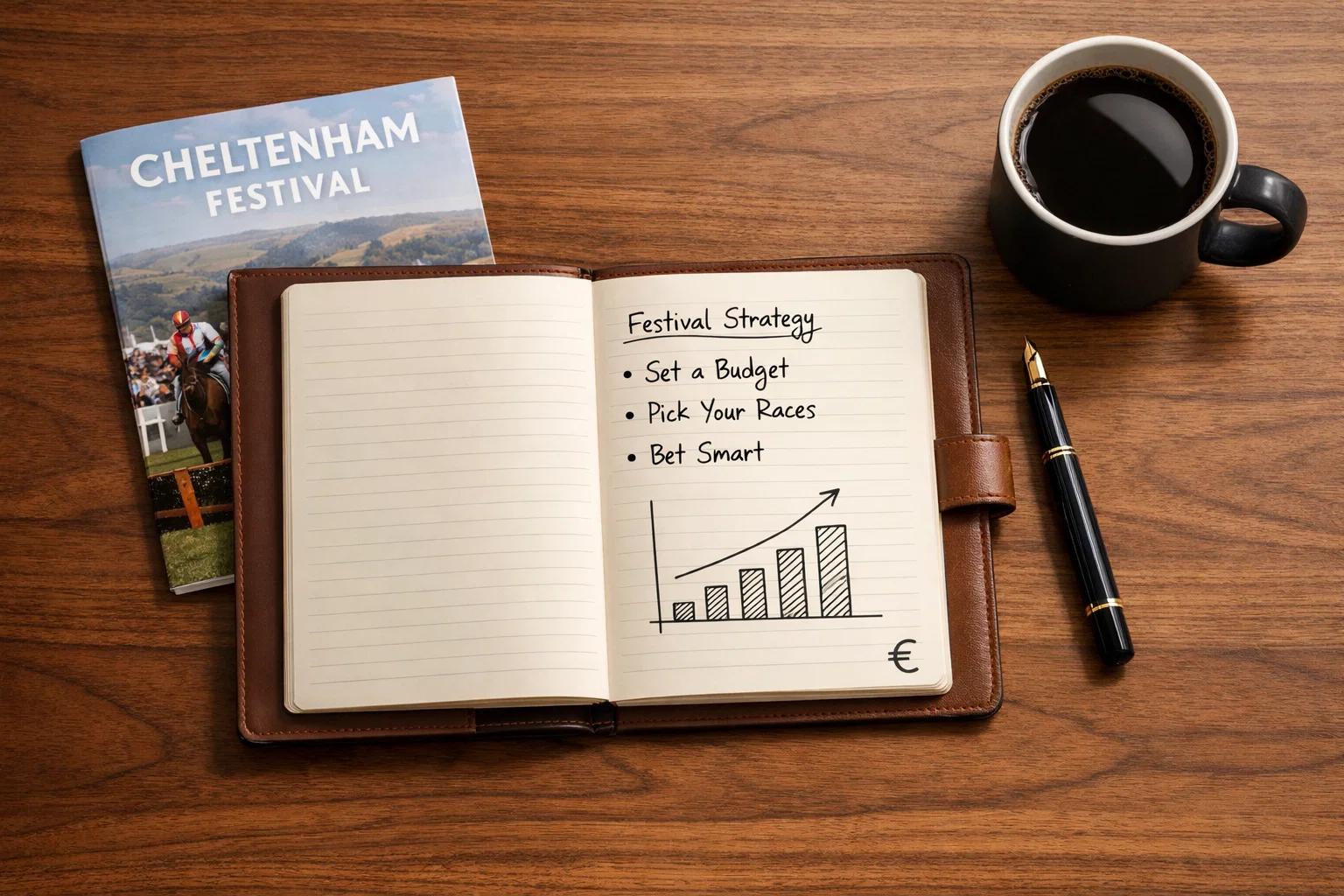
- Cheltenham Betting Strategy Starts Before the First Race
- Building a Festival Bankroll: How Much and How to Split It
- Identifying Value: When the Odds Are Wider Than They Should Be
- Three Phases of Cheltenham Betting: Ante-Post, Week-Of, Day-Of
- The Favourite Trap: Why 29% Changes Your Staking
- Staying in the Game: Discipline Across Four Days
Cheltenham Betting Strategy Starts Before the First Race
A Cheltenham betting strategy that begins on the morning of the first race is already behind. The Festival is not a single event — it is a four-day sequence of twenty-eight races spread across distinct race types, ground conditions that evolve as the turf takes punishment, and a betting market that shifts from ante-post speculation months in advance to frantic morning-of-race adjustments. Approaching it without a framework is like walking into a four-day poker tournament with no idea how many chips you have. The full picture is in our Cheltenham betting guide.
The punters who consistently outperform during Festival week share a common trait: they treat the meeting as a campaign rather than a series of isolated bets. That means setting a bankroll before the first declaration is published, identifying where value is most likely to appear across different race categories, understanding the timing windows that create price advantages, and maintaining the discipline not to chase losses when Tuesday’s bets don’t land. None of this is glamorous. Strategy rarely is. But it is what separates punters from gamblers, and over four days and twenty-eight races, the difference compounds in ways that become impossible to ignore.
This guide lays out a structured approach to Cheltenham betting that you can adapt to your own budget and risk appetite. It is not a set of tips — it is the framework that sits underneath tips and decides how much of your money any single tip deserves.
Building a Festival Bankroll: How Much and How to Split It
The first question is the one most people skip: how much are you prepared to lose? Not how much you hope to win — that’s a fantasy, not a plan. Your Festival bankroll should be an amount that, if it went to zero across four days, would cause annoyance but not hardship. For some people that is fifty pounds; for others it is five hundred. The number itself doesn’t matter. What matters is that it is set in advance, ring-fenced from other money, and treated as the total allocation for the entire meeting.
With a bankroll defined, the next step is dividing it. Three models are worth considering, each with a different risk profile.
The simplest is fixed stakes. You divide your total bankroll by the number of bets you plan to place — let’s say twenty over four days — and wager the same amount on each. A £200 bankroll gives you £10 per bet. The appeal is predictability: you know exactly how many bets you can place, you never risk blowing through your funds early, and the emotional pressure of adjusting stakes is removed entirely. The downside is that it treats all bets equally, regardless of how strongly you rate them. A NAP in the Champion Hurdle gets the same stake as a speculative each way punt in a 24-runner handicap.
The second model is percentage staking. Instead of a fixed amount, you wager a fixed percentage of your current bankroll on each bet — typically between 2% and 5%. If your bankroll is £200 and you stake 3% per bet, your first wager is £6. If the bankroll grows to £250 after a winner, your next bet increases to £7.50. If it shrinks to £150, the stake drops to £4.50. This approach automatically adjusts to your fortunes — you bet more when you’re winning and less when you’re losing. It is the mathematical equivalent of protecting your downside while letting your upside run. The drawback is that it requires recalculation before every bet, and early losses reduce subsequent stakes to the point where recovery becomes difficult without a big-priced winner.
The third model is a simplified Kelly criterion. The Kelly formula calculates the optimal stake based on your estimated probability of winning and the odds being offered. If you believe a horse has a 40% chance of winning and the odds are 3/1, the Kelly formula suggests staking approximately 15% of your bankroll. In practice, most punters who use Kelly apply a fractional version — half-Kelly or quarter-Kelly — to reduce variance. The advantage is that it forces you to quantify your opinion before betting: if you can’t assign a probability, you can’t calculate a stake, and perhaps you shouldn’t be betting at all. The disadvantage is that it relies on your probability estimates being accurate, and most people are worse at this than they think.
For the Cheltenham Festival specifically, the volatility factor matters. William Hill projects that approximately £450 million will be wagered across the four days in 2026, and that money flows through a market where the favourite wins less than a third of the time. This is not a low-variance environment. Whichever staking model you choose, build in a buffer. If you plan twenty bets, ensure your bankroll can handle twenty-three or twenty-four, because the Festival has a way of presenting opportunities you hadn’t anticipated — a non-runner reshaping a race, a going change creating unexpected value — and you want the flexibility to act when they arise.
One final point on bankroll construction: never borrow to bet. It sounds obvious, but Cheltenham week carries a particular emotional charge that makes otherwise sensible people override their own rules. Set the number, commit to it, and treat it as entertainment expenditure. If you finish the week with money left over, you’ve done well. If you’ve grown it, you’ve done better. But the goal of bankroll management is survival first and profit second.
Identifying Value: When the Odds Are Wider Than They Should Be
Value is the single most important concept in betting, and also the most misunderstood. A value bet is not a horse that you think will win. It is a horse whose probability of winning is higher than the odds imply. These are different things, and conflating them is how most punters lose money over time.
Here’s the mechanics. When a bookmaker offers a horse at 4/1, the implied probability of that horse winning is 20% (1 divided by 5, where 5 is the decimal equivalent of 4/1). If your analysis suggests the horse actually has a 28% chance of winning, the bet has value — even though the horse is more likely to lose than to win. Over a hundred such bets, you’d expect to profit because you’re consistently getting paid at a rate that exceeds the underlying probability. That is value. It has nothing to do with certainty and everything to do with price.
At Cheltenham, the opportunities to find value tend to cluster in specific places. The marquee races — the Gold Cup, the Champion Hurdle, the Champion Chase — attract enormous public interest and heavy media coverage, which means the market on these races is relatively efficient. Millions of pounds are wagered, prices are scrutinised by thousands of sharp eyes, and the odds converge on a consensus that’s hard to beat. You can still find value in these races, but it requires a strong contrarian view backed by data that the market hasn’t fully priced in.
The Festival handicaps, by contrast, are a different ecosystem. Large fields, diverse form profiles, and the inherent difficulty of handicapping National Hunt horses create an environment where bookmakers’ tissue prices are less reliable. The gap between the favourite’s implied probability and its actual win rate is a useful illustration. The Champion Hurdle has the highest favourite strike rate at the Festival — 52% since 2000 — while the Coral Cup, a competitive handicap hurdle, sees the favourite win just 8% of the time over the same period. That 44-percentage-point gulf tells you where the market is confident and where it’s guessing. Handicap markets, by their nature, spread probability across many runners, and that spread creates pricing inefficiencies that form-based analysis can exploit.
To apply this at Cheltenham, start by converting the odds on your target horse into implied probability. Then ask yourself three questions. First, does this horse’s form on today’s going support a win probability higher than the implied figure? Second, does the trainer’s Festival record in this type of race add or subtract from that probability? Third, is there a plausible scenario — pace, position, ground — in which this horse wins the race? If all three answers are positive and the implied probability feels too low, you may have a value bet. If any answer is negative, the price needs to compensate for the weakness, and the bar for value rises accordingly.
Value identification is not a guarantee of winners. It’s a discipline that, applied consistently over the course of a Festival, tilts the expected return in your favour. Some value bets will lose — many will, in fact. The skill is in the process, not the outcome of any single race.
Three Phases of Cheltenham Betting: Ante-Post, Week-Of, Day-Of
The Cheltenham betting market doesn’t begin on the first morning of the Festival. It opens months in advance, and each phase of that timeline carries a different risk-reward profile. Understanding where you are in the cycle — and adjusting your approach accordingly — is a strategic advantage that most casual punters ignore entirely.
The first phase is ante-post, which typically runs from the autumn through to the final declarations. Ante-post prices are available on the major races from October onwards, and they offer the widest odds you’ll find because the market is pricing in enormous uncertainty: horses might not make it to the race through injury, the going might render their form irrelevant, or a rival might emerge that reshapes the contest. The trade-off is straightforward. Ante-post prices are bigger because you accept the risk of losing your stake if the horse doesn’t run. There is no refund for non-runners in standard ante-post markets, unless you specifically take a Non-Runner No Bet offer where available.
For punters who do their homework early and have conviction in a particular horse’s Festival target, ante-post can be immensely rewarding. A horse that opens at 16/1 in November for the Gold Cup and goes off at 5/1 in March has delivered value to anyone who backed it early — even if it doesn’t win. The key is selectivity. Ante-post bets should be reserved for horses with a clear path to their target race, trained by stables with a strong record of getting horses to the Festival in peak condition. Speculative ante-post punts on unexposed types look appealing at big prices, but the non-runner risk eats into expected returns more aggressively than the headline odds suggest.
The second phase is the week of the Festival itself — roughly the five or six days between final declarations and race day. This is when the market transitions from speculative to informed. The declarations are published, the going is assessed, and the overnight betting markets begin to form. Prices in this window are shorter than ante-post but longer than morning-of-race odds, and they come with the advantage of confirmed runners. You know the horse is in the race; the uncertainty that justified the bigger ante-post price has been removed. For many punters, this is the sweet spot: prices that still carry a margin of value but without the non-runner risk that ante-post demands.
The third phase is race day itself, from the moment the early morning markets open until the off. Prices in this window are driven by volume — tens of millions of pounds flowing through the major operators within hours. Early morning prices can be more generous than starting price because the weight of casual afternoon money tends to compress the favourite and push outsiders out further. If you have conviction in a selection, backing it between 8am and 10am on race morning, particularly with Best Odds Guaranteed active, captures the widest available price with a built-in safety net. Waiting until the final minutes before the off exposes you to market volatility without any compensating advantage.
A sensible Festival strategy allocates bets across all three phases. Reserve a portion of your bankroll for ante-post opportunities where you have genuine early conviction. Commit the majority during the week-of phase when runners are confirmed. And keep a reserve for race-morning opportunities that emerge from late market intelligence — a going change, a surprise declaration, an unexpected drifter that opens up value elsewhere in the market.
The Favourite Trap: Why 29% Changes Your Staking
Timing is half the battle; knowing what not to back is the other half. Here is a number that should be pinned above every punter’s desk during Cheltenham week: since 2000, starting favourites have won just 29.2% of all Festival races — 188 winners from 644 contests. That means more than two out of every three favourites have lost. If you had blindly backed every favourite at starting price over a quarter of a century of Cheltenham racing, you would be substantially down on your investment.
The year-to-year variation adds another layer. In 2025, favourites managed just 9 wins from 28 races — a 32.1% conversion rate, below even the already modest long-term average. In the best year for favourites on record — 2022 — the figure peaked at 42.9%, with 12 winners from 28 races. Even in that exceptional year, more than half the favourites lost. The favourite trap is not an anomaly or a bad-luck streak. It is a structural feature of Festival racing, driven by the quality and depth of the fields, the unpredictability of ground conditions, and the fact that the best-handicapped horses in Ireland and Britain converge on the same week.
What does this mean in practice? It means that a staking plan built around backing favourites is mathematically vulnerable. The favourite’s implied probability at, say, 2/1 is 33.3%. If the actual win rate is 29.2%, you are consistently paying more than the horse is worth. Over a single race, that discrepancy is invisible. Over twenty-eight races across four days, it bleeds your bankroll dry.
The practical response is not to avoid favourites entirely — some favourites win, and the Champion Hurdle favourite wins more often than not. It is to treat the favourite status as a starting point rather than a conclusion. Ask whether this particular favourite, in this particular race, on today’s ground, against this specific field, has a probability of winning that exceeds its implied probability. If yes, back it. If no, look elsewhere. The 29.2% figure doesn’t tell you which favourites to oppose; it tells you that opposing favourites in general is not the reckless strategy it might intuitively seem. In fact, given the Festival’s structural volatility, it is often the more rational one.
One further point: the day of the week matters. Betway’s data shows that Gold Cup day — Friday — has historically been the worst day for favourites, with five of the past twenty-five Fridays producing zero favourite winners. If you’re going to be selective about when to back and when to fade the market leader, Friday is the day where the data most strongly supports scepticism.
Staying in the Game: Discipline Across Four Days
The Festival’s four-day structure is its greatest spectacle and its most dangerous trap. Tuesday’s losses have a way of infecting Wednesday’s decisions. A punter who goes 0/7 on day one faces an almost irresistible urge to increase stakes on day two, chasing the losses with bigger bets on less considered selections. This is the fastest route to a blown bankroll, and it happens to experienced punters as readily as to beginners.
The antidote is pre-commitment. Before the first race on Tuesday, decide how your bankroll is allocated across the four days. A simple equal split — 25% per day — works well enough. A more nuanced approach might weight Thursday and Friday slightly higher, because the championship races on those days tend to have more form data available and the going is more settled after two days of racing. However you split it, the critical point is that Wednesday’s allocation is not raided to recover Tuesday’s losses. Each day operates as its own mini-campaign within the broader strategy.
Emotional management is as important as mathematical management. The Festival generates an atmosphere that is specifically designed to encourage betting — large crowds, live coverage, promotional offers from every operator, and the social pressure of participating in what feels like a national event. Recognising these environmental pressures for what they are — external influences on your decision-making that have nothing to do with the probability of any horse winning — is the first step to neutralising them.
The broader industry context underlines why discipline matters. The British Horseracing Authority’s 2024 Racing Report noted that total betting turnover on racing fell by 6.8% year-on-year, continuing a decline that has seen turnover drop 16.5% since 2022. Richard Wayman, BHA Director of Racing, has been candid about the cause: “I’ve no doubt that [the decline in betting turnover] is headed by the impact of affordability checks and the extent to which they have resulted in people either stopping betting or placing their bets with unlicensed operators where such checks don’t take place.” That regulatory landscape is the backdrop to your Festival week. Responsible gambling tools — deposit limits, session time reminders, cooling-off periods — are not bureaucratic inconveniences. They are structural safeguards that align with the same disciplined approach this guide advocates. Set a deposit limit before the Festival starts. Use it. If you find yourself trying to remove it mid-week, that’s the strongest possible signal that you should stop for the day. The limits that protect a bankroll are in responsible gambling.
The Gold Cup on Friday is the race most punters dream about. If your bankroll management is sound, you’ll arrive at that race with funds, with options, and with the clarity that comes from having stuck to a plan for three days. That is the real reward of discipline — not the absence of losing bets, but the presence of firepower when the moment that matters most finally arrives. Strategy is what separates punters from gamblers, and nowhere is that separation more visible than in the state of your bankroll on the final afternoon.
