
 Available in US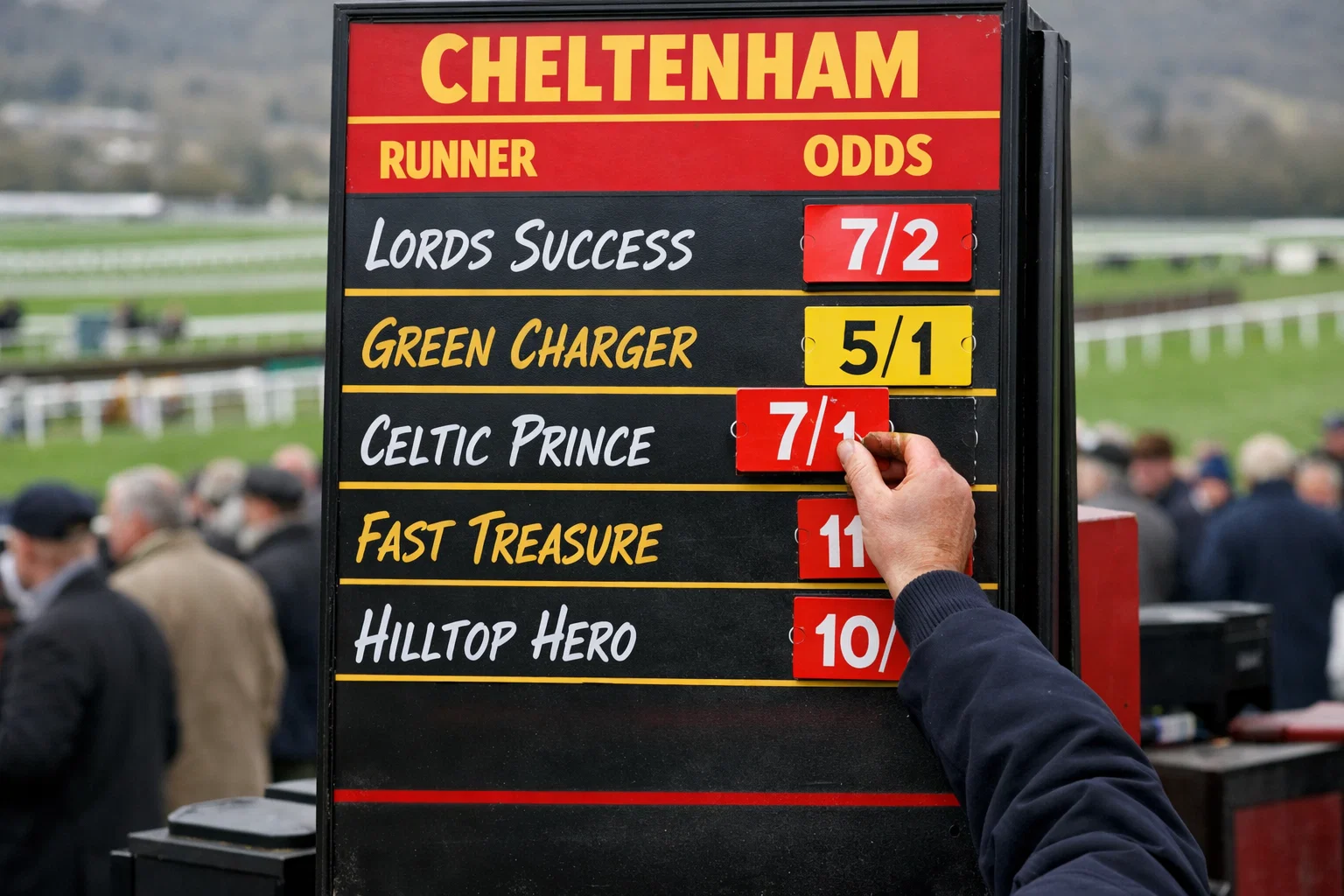
Best Odds Guaranteed: The Feature That Quietly Adds Value to Every Cheltenham Bet
Best Odds Guaranteed is one of those bookmaker features that most punters have heard of, vaguely understand, and rarely think about until it pays out in their favour. At Cheltenham, where prices can move dramatically between the moment you place your bet and the moment the race goes off, BOG quietly adds value to every qualifying wager. It is not flashy, it is not marketed as aggressively as free bet offers, but across a four-day festival with twenty-eight races, it can make a meaningful difference to your overall return. The wider context is set out in our Cheltenham betting guide.
The principle is simple: BOG turns a standard bet into a free upgrade. You take a price on a horse, the starting price on the day drifts to something larger, and the bookmaker pays you at the bigger number. You captured the horse at the price you wanted, and the market movement worked in your favour rather than being irrelevant. At a festival where market confidence shifts with every piece of going news, every jockey booking and every whisper from the parade ring, price drift is not an occasional occurrence — it happens in the majority of races.
Understanding exactly how BOG works, what it covers and where its limits sit is worth ten minutes of your time before the festival starts. It will not turn a losing week into a profitable one, but it can turn a marginal week into a comfortable one.
How BOG Works: Board Price, SP and What Happens at the Off
When you place a bet with a bookmaker that offers Best Odds Guaranteed on UK and Irish horse racing, you lock in the price displayed at the time of your bet — the board price. If the Starting Price (SP) when the race goes off is higher than the price you took, the bookmaker upgrades your bet to the SP automatically. If the SP is lower, you keep your original price. Either way, you get the better of the two numbers.
The mechanism works because SP is determined independently. It is calculated from the on-course bookmakers’ boards at the moment the race starts, reflecting the final state of supply and demand in the betting ring. Off-course turnover on British horse racing amounted to approximately £3.33 billion as of March 2023, according to the Gambling Commission via Statista. Within that vast market, individual horses can see their SP drift significantly from the morning price if, for example, money arrives late for a rival or a piece of negative news emerges about the horse you backed.
At Cheltenham, where late market moves are the norm rather than the exception, the frequency of SP drifts is higher than at a typical midweek meeting. Going changes announced an hour before a race can cause a reshuffling of the market. A jockey switch can spook money away from one horse and onto another. The sheer volume of speculative money entering the market from casual festival punters — many of whom back favourites — can compress the favourite’s price and push the rest of the field out to longer odds. All of these dynamics increase the probability that the SP on your selection will be higher than the price you took.
BOG applies automatically at most major UK bookmakers. You do not need to tick a box or activate a setting. If the bookmaker offers BOG on the race, your bet is covered from the moment you place it. The payout simply reflects whichever price is higher — your board price or the SP.
A Worked Example: £10 on a 5/1 Shot That Drifts to 8/1
Suppose you back a horse in the Coral Cup at 5/1 on Wednesday morning with a £10 win stake. By the time the race goes off, late money has arrived for a rival and your horse’s SP has drifted to 8/1. Without BOG, you would be paid at your original 5/1, collecting £60 (£50 profit plus your £10 stake). With BOG, you are paid at 8/1 — the higher price — collecting £90 (£80 profit plus your £10 stake). That is an extra £30 for doing nothing other than having an account with a bookmaker that offers the feature.
The flip side is equally instructive. If your horse is backed late and the SP shortens from 5/1 to 3/1, BOG protects you in the other direction — you keep your original 5/1. You are insulated from the price compression that late money creates. In 2025, favourites managed only nine wins from twenty-eight festival races, as William Hill reported, which means the majority of races saw the favourite’s price hold or shorten while other runners drifted. If you were on one of those drifters, BOG rewarded you for taking the early price.
Over the course of a four-day festival, these upgrades accumulate. Even if the drift is modest — your 4/1 becomes 9/2, your 10/1 becomes 12/1 — the incremental gain across a dozen or more bets adds meaningful value. A punter placing twenty bets across the festival who captures an average BOG upgrade of half a point in odds on a third of those bets is quietly banking extra profit without changing their selection process at all.
Limitations and Exclusions: What BOG Doesn’t Cover
BOG is not universal, and the exceptions matter. Most bookmakers restrict BOG to win bets placed at fixed odds on UK and Irish horse racing. Each way bets are typically covered on the win part only — the place part is paid at the fraction of your original price, not the fraction of the SP. This is a common source of confusion and occasional disappointment.
Some bookmakers impose time restrictions. BOG might only apply to bets placed on the day of the race, excluding ante-post wagers. Others apply BOG from a specific time — say, 9 a.m. on race day — meaning a bet placed at 8:55 a.m. would not qualify. During Cheltenham week, when early-morning prices can be significantly different from afternoon prices, this timing detail matters.
Enhanced odds promotions are usually excluded from BOG. If you take a bookmaker’s “boosted price” on a Cheltenham selection — say, a horse enhanced from 4/1 to 6/1 as a promotional offer — the BOG guarantee typically does not apply to that enhanced price. You get the promotional odds, but if the SP goes higher, you are stuck at 6/1 rather than being upgraded further. Always check whether a boosted price forfeits your BOG coverage before accepting it.
Finally, BOG does not apply to bets placed on betting exchanges, because exchanges operate on a peer-to-peer model where there is no bookmaker to absorb the cost of the guarantee. If you use both a traditional bookmaker and an exchange — a common approach among experienced punters — be clear about which bets carry BOG protection and which do not. The difference can be substantial on a volatile Cheltenham afternoon. Prices are compared side by side in Cheltenham odds.
There is also a less obvious limitation that catches punters out during festival week: maximum payout caps. Some bookmakers limit the additional profit generated by a BOG upgrade to a fixed amount — for example, £500 or £1,000 extra. If you placed a large stake on a horse at 4/1 that drifts to 10/1, the theoretical BOG uplift could be significant, but the cap may limit the actual additional payout. For most recreational punters, this cap will never be relevant. For anyone placing larger stakes across the four days, it is worth checking the specific BOG terms with your bookmaker before the first race on Tuesday.
