
 Available in US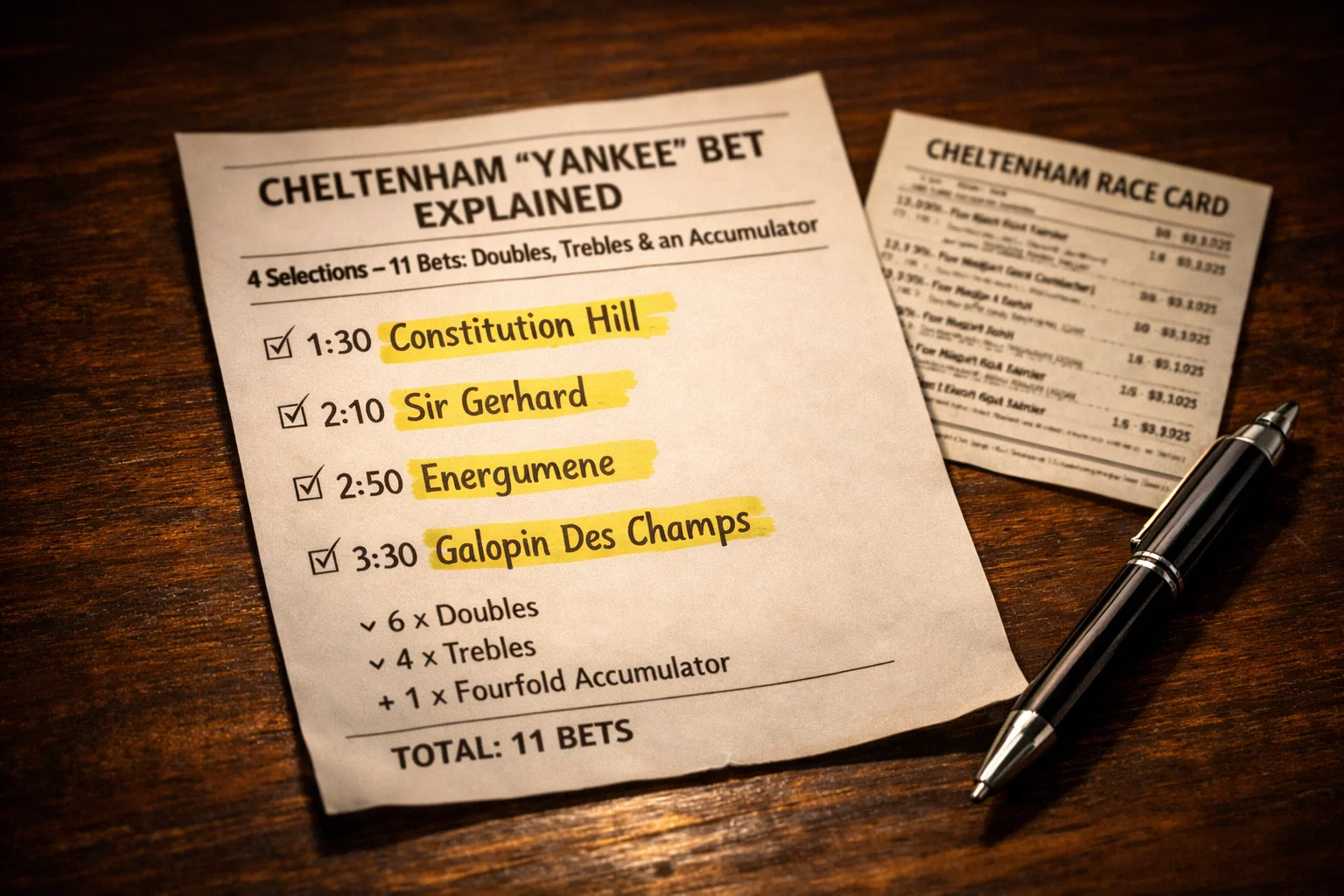
The Yankee Bet: A Full Cover Without the Singles
The Yankee sits between the accumulator and the Lucky 15 in the hierarchy of multi-bets, and it occupies a specific niche at Cheltenham. Like the Lucky 15, it takes four selections and combines them into multiple bets. Unlike the Lucky 15, it drops the four singles, leaving you with eleven bets: six doubles, four trebles and one four-fold. The result is a bet type that costs less per unit than a Lucky 15 but requires at least two winners to generate any return at all. The wider context is set out in our Cheltenham betting guide.
That structural difference — eleven bets, no singles — defines who the Yankee is for. It suits punters who are confident that at least two of their four picks will win. If you expect only one winner, the Lucky 15 is better because the single catches that scenario. If you expect two or more, the Yankee delivers a slightly higher return per unit stake because you have not spent money on singles that would only pay out if exactly one horse wins. The Yankee rewards multiple winners, and at Cheltenham, that distinction matters.
Inside the Yankee: Six Doubles, Four Trebles, One Four-Fold
Take four selections — call them A, B, C and D — from four different Cheltenham races. The Yankee generates the following bets. The six doubles are AB, AC, AD, BC, BD and CD. The four trebles are ABC, ABD, ACD and BCD. The four-fold is ABCD. Total: eleven bets at your unit stake.
If you play a £1 Yankee, you are spending £11. That is four units cheaper than a £1 Lucky 15 (which costs £15), and the saving comes entirely from dropping the singles. The doubles are the most likely combination to return — you need just two of four selections to win for a double to pay. The trebles require three, and the four-fold requires all four.
The returns from a Yankee are driven primarily by the doubles when two winners land, and by the trebles when three come in. If all four win, the four-fold adds a substantial bonus on top. To illustrate: if two of your four selections win at 3/1 and 5/1, the returning double pays 23/1 (calculated as 4 × 6 − 1), giving you £23 profit on a £1 unit. That is your only winning bet from the eleven, but a £23 return on an £11 outlay is a £12 profit — more than doubling your money from a partially successful afternoon.
The escalation when three or four win is where the Yankee reveals its strength. Three winners at average odds of 4/1 produce three winning doubles, one winning treble and, if the treble lands, a meaningful cumulative return. The numbers become genuinely impressive when the odds are longer. A Yankee with four winners at prices between 3/1 and 8/1 can return several hundred pounds from a modest unit stake.
Yankee vs Lucky 15: When Dropping Singles Makes Sense
The decision between a Yankee and a Lucky 15 at Cheltenham comes down to one question: how many of your four selections do you realistically expect to win? Since favourites at the festival have won only 29.2% of the time since 2000, as Betway data shows, the probability of any individual selection winning is already modest. The probability of exactly one winning from four is higher than the probability of two or more winning — which means the Lucky 15, with its singles safety net, is the safer bet structure for most Cheltenham scenarios.
The Yankee becomes the better choice when your four selections are at longer odds and you are specifically targeting the doubles and trebles rather than protecting against a one-winner day. If all four picks are priced between 6/1 and 14/1, the singles in a Lucky 15 would return relatively small amounts if only one lands — and the consolation bonus, while helpful, would not transform the outcome. In this scenario, the four extra units you save by choosing a Yankee over a Lucky 15 are better kept in your pocket or redirected to a separate bet.
There is also a psychological dimension. The Yankee forces you to commit to the belief that you will find at least two winners from four. That commitment sharpens your selection process — you cannot include a speculative 33/1 shot just because the Lucky 15’s single will catch it if nothing else lands. Every pick needs to justify its place on merit, because a single winner from a Yankee returns nothing.
Using a Yankee at Cheltenham: Ideal Scenarios and Pitfalls
The ideal Cheltenham Yankee contains four selections at mixed odds, drawn from races where your form analysis gives you genuine confidence. A blend of a 3/1 shot from a championship race, a 5/1 pick from a competitive novice event, and two longer-priced handicap fancies at 8/1 and 10/1 gives the structure room to work. If the two shorter-priced selections win, the doubles return a healthy profit. If one of the longer-priced picks also obliges, the treble lifts the payout significantly.
The best year for favourites at Cheltenham was 2022, when market leaders won at a rate of 42.9% according to Betway. In a year like that, Yankees built around well-priced favourites and near-favourites would have performed strongly — multiple winners landing from the same card was more common than usual. In a typical year, however, the reality is harsher. Two winners from four at Cheltenham is a good day. Three is an excellent day. Four is the kind of day you remember for years.
The pitfall to avoid is treating the Yankee as a cheaper Lucky 15. It is not. It is a structurally different bet with a higher minimum win requirement. If you are not confident that at least two of your picks will oblige, the Yankee is the wrong vehicle. A Lucky 15 gives you the safety of singles and the consolation bonus. A straight four singles gives you the maximum return per winner with no dead bets. The Yankee only outperforms when multiple winners arrive — and at Cheltenham, that outcome is never guaranteed.
Budget your Yankee as an entertainment bet, not a core strategy. Its role in a festival betting plan is to provide leveraged exposure to a good day — the kind of day where two or three of your fancies land and the combination bets amplify the returns beyond what individual singles would produce. Keep the unit stake modest, select with discipline, and accept that the Yankee will lose more often than it wins. When it does win, the structure does the heavy lifting. Add the singles and you have a Lucky 15.
One practical tip: consider running a Yankee on one specific day of the festival rather than daily. Identify the day where your form analysis gives you the highest number of confident picks — Tuesday with its championship races and readable form is often a natural choice — and concentrate your Yankee there. A focused, one-day Yankee on your four strongest selections will outperform four consecutive daily Yankees built with diminishing conviction and depleted bankroll. Quality of picks matters more than frequency of bets, and the Yankee rewards quality above all else.
