
 Available in US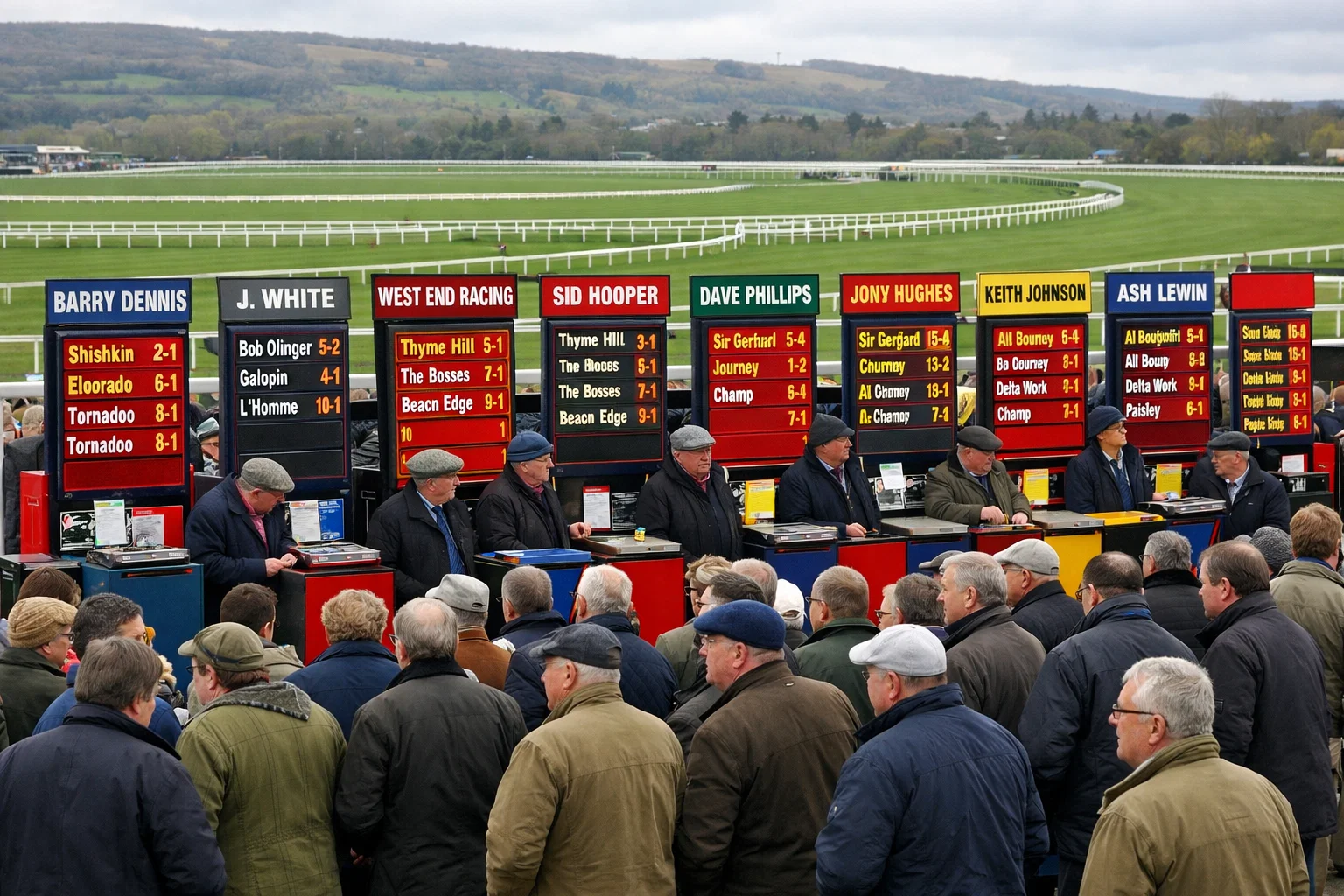
On-Course Betting at Cheltenham: What Changes When You’re at Prestbury Park
Betting at the racecourse is a fundamentally different experience from betting on your phone at home. The information arrives differently — through the buzz of the parade ring rather than a Racing Post analysis. The prices move differently — on physical bookmaker boards that you can watch being rubbed out and rewritten in real time. And the psychological environment is different — seventy thousand people generate an energy that no app can replicate and no sensible bettor should ignore. The racecourse betting experience has rules the app does not teach you. The wider context is set out in our Cheltenham betting guide.
If you are attending the Cheltenham Festival in person, understanding your on-course betting options and planning your approach before you walk through the gates will save you time, money and frustration during the busiest racing week of the year. The on-course market offers advantages that the online market does not, but it also imposes constraints — cash management, queuing, signal strength — that require preparation.
Your Options: Betting Ring, Tote Windows and Mobile Apps
There are three ways to place a bet at Cheltenham Racecourse: with an on-course bookmaker in the betting ring, at a Tote window, or via a mobile app on your phone. Each has distinct characteristics.
The betting ring is the traditional heart of on-course betting. Rows of independent bookmakers stand on their pitches, each displaying odds on numbered boards. You approach the bookmaker, state your bet, hand over cash and receive a ticket. The price you see on the board is the price you get — there is no lag between screen and execution as there sometimes is online. On-course bookmakers also contribute to the formation of the Starting Price, which means the ring is not just a place to bet; it is part of the pricing mechanism that determines what every off-course punter is paid.
Off-course betting turnover on British horse racing amounted to approximately £3.33 billion as of March 2023, according to the Gambling Commission via Statista. The on-course market is a fraction of that figure, but its influence on price formation is disproportionate to its size. The odds you see on the bookmaker boards in the Cheltenham ring ultimately determine the SP that settles millions of pounds in off-course bets. Watching those boards shift in the final minutes before a race is one of the most informative experiences available to any punter.
Tote windows offer pool betting — the Placepot, Jackpot, Exacta and standard win and place pools. The Tote operates differently from fixed-odds bookmakers: your return is determined by the total pool and the number of winning tickets, not by a fixed price. During Cheltenham week, the Tote pools are among the largest of the year, which can produce generous payouts on unpopular winners. The disadvantage is that you do not know your exact return until after the race.
Mobile apps work at the racecourse just as they do at home, provided you have a signal. Most major bookmakers’ apps function normally on-course, and you can place bets, cash out and monitor live odds without joining a queue. The practical advantage of the app is speed and convenience; the disadvantage is connectivity, which we will address shortly.
Mobile Betting at the Racecourse: Connectivity, Cash Out and Live Odds
Using your mobile betting app at Cheltenham is the most convenient option, but it depends entirely on network connectivity — and that connectivity is under severe strain during festival week. The total attendance at UK racecourses exceeded 5.031 million in 2025, according to the BHA Racing Report, and Cheltenham accounts for a disproportionate share of that figure across just four days. When sixty to seventy thousand people are concentrated in a single venue, all attempting to use mobile data simultaneously, network speeds can drop dramatically.
The practical implications are real. A bet that takes two seconds to place on your sofa may take thirty seconds or fail entirely at the racecourse. If you are trying to place a bet in the final minutes before a race, a slow connection can mean missing the price you wanted or missing the race entirely. Cash out, which requires a live connection to the bookmaker’s servers, can be similarly unreliable. Do not assume that cash out will be available at the exact moment you need it.
Several strategies mitigate the connectivity problem. Place your bets well in advance of each race — ten to fifteen minutes before rather than two minutes before. Use the racecourse’s Wi-Fi if available, though public Wi-Fi at large events is often no faster than mobile data. Keep your app logged in and your bet slip pre-loaded so that you only need to confirm the stake and press “Place Bet” rather than navigating the full interface. And carry cash as a backup. If your phone fails you in the final minutes before the Gold Cup, the on-course bookmaker in the ring will take your money without needing a 4G signal.
Practical Tips: Cash, Queues and Timing Your Bet
Cash is still the primary currency in the betting ring. On-course bookmakers accept cash bets and pay out in cash. Bring enough physical money for the bets you plan to place, plus a margin for impulse opportunities. ATMs at the racecourse exist but charge withdrawal fees and develop long queues by mid-afternoon. Drawing cash before you arrive is cheaper and less time-consuming.
Queues at Tote windows can be lengthy during popular races, particularly on Gold Cup Day. If you want to play the Placepot, place it before the first race rather than joining the queue five minutes before the off. The Placepot requires selections for the first six races, so there is no reason to wait — decide your picks in advance and place the bet as soon as the Tote windows open for the day.
Timing your bet in the ring is an art form. Prices in the ring are most volatile in the final ten minutes before a race. If you have a firm selection and the current price is acceptable, bet early and lock it in — you benefit from Best Odds Guaranteed if the SP is higher. If you want to see the market settle before committing, stand near the rails bookmakers and watch the boards. When several bookmakers start rubbing out a horse’s price simultaneously and replacing it with a shorter one, smart money is arriving. When a horse’s price starts lengthening across the boards, confidence is draining.
One final tip: pace yourself. The festival runs for four days with seven races per day. Betting on every race is a recipe for exhaustion and poor decision-making by Thursday afternoon. Select the three or four races per day where you have a genuine opinion, place your bets on those, and enjoy the remainder of the card as a spectator. The racecourse experience is about far more than betting — the atmosphere, the pageantry, the Cheltenham roar on the opening race — and you will appreciate it more if you are not frantically calculating your losses between every race. The pool bet of the week is the Placepot.
If you are attending for the first time, arrive early. The gates open well before the first race, and the morning hours are the best time to explore the racecourse layout, locate the betting ring, find the Tote windows, and identify the best viewing spots. The parade ring, where horses walk before each race, is also worth visiting — seeing the horses in person gives you information that no screen can provide. A horse that moves freely and looks calm in the parade ring is a different proposition from one that is sweating, pulling or showing signs of anxiety. It is not scientific, but experienced racegoers swear by the parade ring as a final check before committing their stake.
