
 Available in US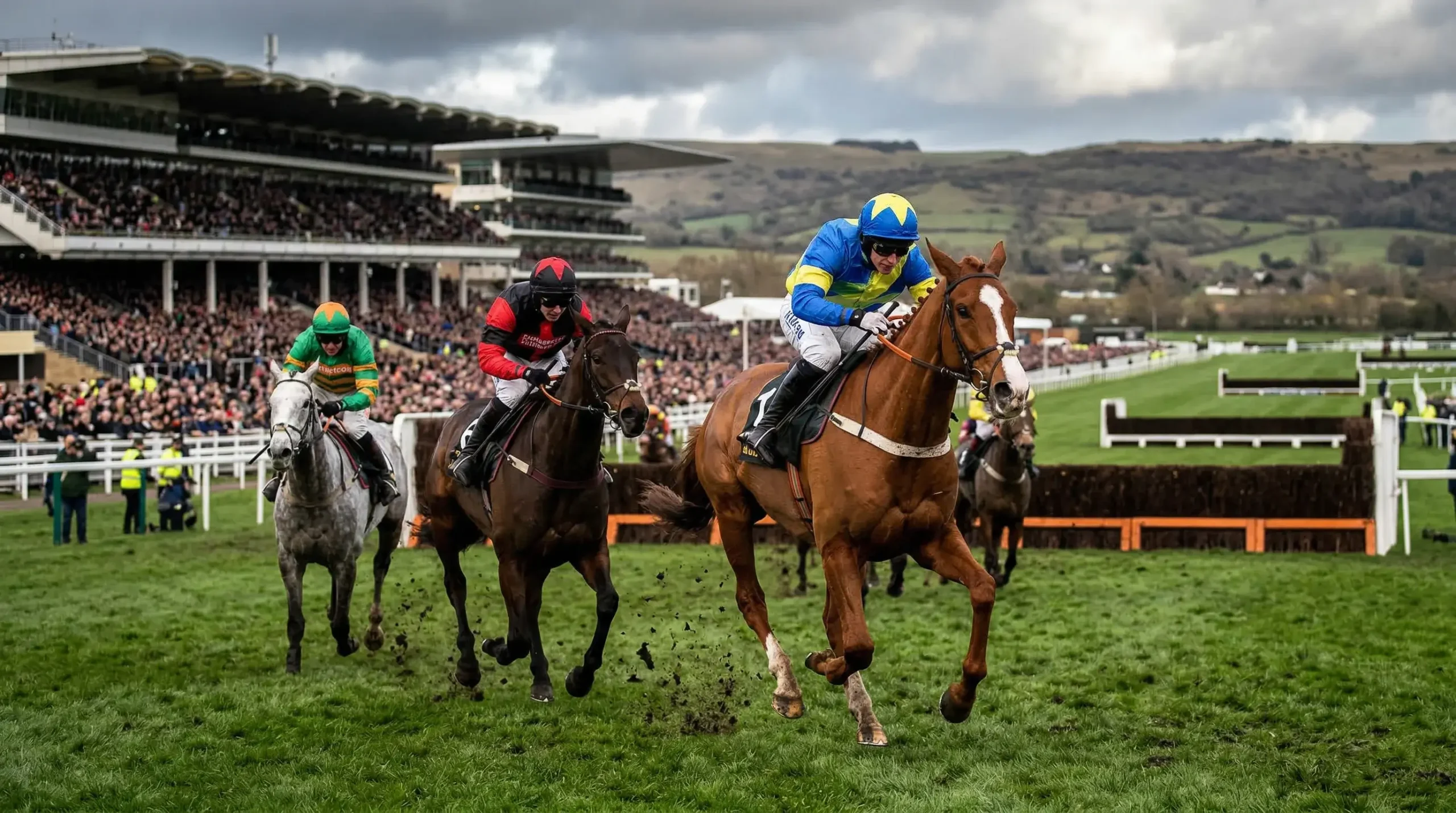
Gold Cup Betting: Why Friday’s Feature Race Changes the Punting Calculus
The Cheltenham Gold Cup is the blue riband of jump racing, and it demands a different bet. Everything about this race — the three miles and two furlongs, the twenty-two fences, the quality of the field, the weight of public money — sets it apart from every other contest during festival week. It is the race that defines careers for horses, trainers and jockeys, and it is the race that attracts the most casual betting interest of the entire meeting. The wider context is set out in our Cheltenham betting guide.
That combination of prestige and public attention creates a distinctive market. Prices can be shorter than they should be on the sentimental favourites, and longer than they should be on the form horses that the casual punter overlooks. The Gold Cup also sits on Friday — Gold Cup Day — when the crowd is at its largest and the atmosphere is at its most charged. Every bookmaker on the racecourse and online knows that more money flows through the Gold Cup than any other race on the card, and they price accordingly.
For the serious punter, this means the Gold Cup is simultaneously the most analysed race at the festival and the one where the market is most likely to misprice a contender. The data tells a story the crowd rarely reads. History, age trends and going conditions all point to specific profiles that win this race, and understanding those profiles is where the edge lives.
Gold Cup Winners Since 2016: Age, Going and Price Patterns
The Gold Cup has a type, and the data over the past decade makes it unmistakable. According to William Hill, every single one of the last ten Gold Cup winners has been aged between seven and nine years old. Not one horse outside that age bracket has taken the race in a decade. That is not a trend — it is a filter. If your Gold Cup fancy is ten or older, you are betting against a perfect historical record.
Within that age band, eight-year-olds have been the most productive, winning four of the last ten renewals. Seven-year-olds and nine-year-olds have split the rest roughly evenly. The race demands enough experience to handle the unique pressures of Cheltenham’s hill and the sheer physical test of three miles and two furlongs over fences, but not so much mileage that the body is beginning to slow. The sweet spot sits firmly at eight.
Going conditions have varied across recent runnings, but the Gold Cup has been won on everything from good to firm to heavy. What the data suggests is that the going matters less than the horse’s proven stamina and jumping ability. A genuine stayer with clean fencing will handle soft ground; a speed horse that barely stays the trip will not. The going becomes a differentiator only when it turns extreme — genuine heavy ground — at which point it eliminates horses that have not proven they can cope with it.
On price, the Gold Cup has rewarded market leaders more than most Cheltenham races. Five of the last ten winners started as the favourite or second favourite. The prize fund for 2027 stands at £625,000, with the winner taking approximately £351,688, as reported by the Scotsman. That level of prize money ensures that trainers send their very best, which in turn means the form is well exposed and the market tends to get the upper end of the betting roughly right. The value often lies not in opposing the favourite outright, but in identifying the horse at 5/1 or 8/1 that the form data supports more strongly than the market price implies.
2027 Contenders: Form, Fitness and Market Position
The 2027 Gold Cup market has been shaped by a season of trial races that have clarified the picture at the top while leaving enough uncertainty to create genuine betting interest further down the field. As ever, the Irish contingent dominates the upper echelons of the market, reflecting the broader pattern of cross-Irish-Sea superiority that has defined festival betting for over a decade.
The key to reading the 2027 contenders is assessing how each horse fits the Gold Cup profile established by recent winners. Age is the first checkpoint: any contender aged seven, eight or nine deserves serious attention; anything outside that range faces a decade of data arguing against it. Stamina is next. Horses that have won or placed over three miles or further on testing ground are far more likely to handle the demands of the Gold Cup than those stepping up in trip for the first time. The hill at Cheltenham is a brutally honest examiner of stamina, and it exposes pretenders in the final half-mile every year.
Fitness is the third variable, and it is often the hardest to assess from the outside. Trainers manage their Gold Cup horses carefully through the season, sometimes accepting a defeat in a trial to ensure the horse peaks on the day that matters. A below-par run at Leopardstown in February does not necessarily mean the horse is in decline — it might mean the trainer has left something to work with. Equally, a brilliant trial at Haydock in December might leave questions about whether the horse can reproduce that level four months later. Reading between the lines of pre-festival interviews, jockey bookings and supplementary entry decisions gives the best clues.
The market itself is a useful guide, but not an infallible one. Horses that shorten dramatically in the final week before the Gold Cup are doing so because stable confidence is growing and smart money is arriving. Horses that drift suggest either concern about the going, a fitness doubt or a market correction. Track the movements rather than the static prices — the direction of travel tells you more than the number on the screen.
Betting Angles: Favourite Record, Each Way and the Lay Option
The Gold Cup favourite’s record over the last decade is surprisingly strong compared to the broader festival average. Five of the last ten favourites have won, giving a strike rate of 50% — well above the 29.2% average across all Cheltenham races. This does not mean you should blindly back the favourite, but it does mean the Gold Cup is one of the few festival races where the market leader deserves genuine respect. The race attracts the best horses with the most exposed form, and the market tends to read that form accurately at the top end.
Each way is a popular approach for the Gold Cup, and it can work, but the value depends on the size of the field and the price of your selection. In a typical Gold Cup with twelve to fifteen runners, standard place terms pay three places at one-quarter the odds. If you are backing a horse at 8/1 each way, the place return at 2/1 gives you a decent cushion. Below 4/1, the place return becomes marginal relative to your total outlay, and a straight win bet is cleaner. The sweet spot for each way Gold Cup bets sits between 6/1 and 14/1 — long enough for the place return to be meaningful, short enough for the horse to have a realistic chance of hitting the frame.
For more advanced punters, the Gold Cup also offers a lay option through betting exchanges. Laying a horse means betting against it, and the Gold Cup favourite is a common lay in years when the favourite’s price is short but its profile does not match the historical winner template. If the favourite is aged ten or older, has never raced on soft ground, or has a tendency to jump right-handed at Cheltenham’s left-handed track, laying at short odds can be a disciplined, data-backed position. The downside is that you are liable for the payout if the horse wins, so stake sizing matters. Laying a 2/1 favourite for £50 means you lose £100 if it wins, but profit £50 if it does not. The risk must be sized within your overall festival bankroll, not treated as a standalone bet. The opening-day headline races are the Arkle and Supreme.
Whichever angle you choose, the Gold Cup rewards preparation more than any other race on the card. The data is clear: back a seven-to-nine-year-old with proven stamina, a clean jumping record and a trainer with a history at the festival, and you are playing with the odds rather than against them. Ignore those filters, and you are paying for the privilege of watching the race as a spectator rather than collecting as a punter.
