
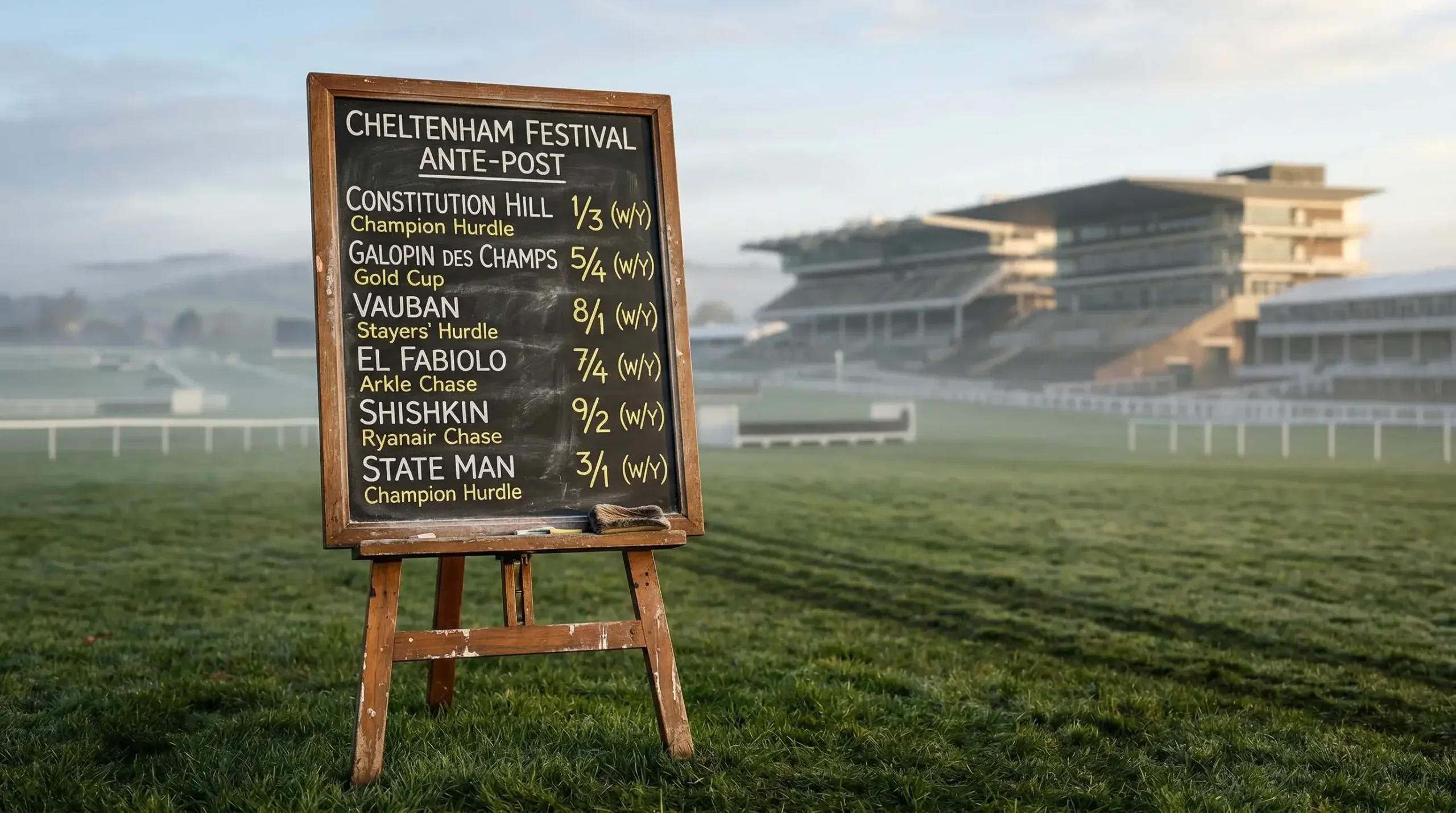
Ante-Post Cheltenham Betting: Why Early Markets Reward Patience and Research
Ante-post Cheltenham betting is where the sharpest punters operate and where the biggest prices are found. Months before the first horse enters the parade ring at Prestbury Park, the markets are open, the odds are generous, and the bookmakers are offering prices that they will almost certainly cut by the time festival week arrives. Early money finds the best prices — and the biggest traps.
The appeal of ante-post is straightforward: you get bigger odds in exchange for taking on more risk. Back a horse in November at 20/1 for the Gold Cup, and by March that price might have halved if the horse wins a key trial. The difference between 20/1 and 10/1 on a winning bet is enormous. But the risk is equally real — if that horse gets injured, changes target or simply never makes the final field, your stake is gone. No refund, no consolation. That is the ante-post contract.
Understanding how and when to engage with the ante-post market is one of the most underrated skills in Cheltenham betting. It is not about guessing winners months in advance; it is about identifying when the available price does not reflect the horse’s true chance, and having the discipline to act on that edge while managing the downside.
The Price Lifecycle: How Cheltenham Odds Shift From November to March
Cheltenham ante-post markets follow a broadly predictable cycle, though the individual price movements within that cycle are anything but predictable. The markets first open in earnest after the previous year’s festival, with bookmakers pricing up the following year’s championship races almost immediately. At this stage, prices are at their widest because the uncertainty is at its peak. A horse priced at 33/1 for next year’s Gold Cup in April might be a perfectly reasonable selection — or it might never run in the race at all.
The first major contraction happens during the autumn, when the National Hunt season begins in earnest. Horses that perform well in early-season Grade 1s and Grade 2s — races at Ascot, Haydock and Down Royal in November — see their Cheltenham prices shorten rapidly. A horse that was 16/1 for the Champion Hurdle in September might be 6/1 by December after an impressive Haydock performance. This is the period where ante-post punters who did their homework earliest get rewarded. The price you locked in at 16/1 is now looking extremely generous.
The second contraction comes in January and February, when the key trials at Leopardstown, Cheltenham itself (the January meeting) and Newbury take place. Trainers begin revealing their festival targets, supplementary entries are made, and the picture sharpens. By this point, most of the easy value has gone. Prices still move, but the gaps between what the market offers and what the horse’s true chance might be are narrower.
The final squeeze happens in the days before the festival. With a record total prize fund of £4,975,000 in 2026, as reported by Paddy Power, the financial incentive for connections to run their best horses is stronger than ever. Late declarations, going updates and stable confidence all produce last-minute shifts. By the morning of each race, the ante-post market has essentially converged with the day-of market, and the premium for early betting has evaporated.
The Risk-Reward Equation: Non-Runners and Lost Stakes
The defining feature of ante-post betting is the non-runner risk. If your horse does not run in the race — for any reason, whether injury, a change of plan by the trainer, or unsuitable ground conditions — your stake is lost. This is the rule at every bookmaker for standard ante-post bets. There is no refund, no transfer to another race, no consolation. The money is gone.
This risk is not trivial. National Hunt horses are athletes operating at extreme physical limits. Tendon injuries, setbacks in training and respiratory issues can strike at any time between the moment you place your bet and the moment the tape goes up. Over a five-month ante-post period from November to March, the probability that at least one of your selections encounters a problem is meaningfully higher than most punters assume.
The compensation for this risk is the price. Since only 29.2% of Cheltenham favourites since 2000 have won their races, according to Betway, the overall market is already volatile. Ante-post adds another layer of uncertainty — not just whether the horse wins, but whether the horse runs. The bookmaker prices this in by offering odds that are longer than what they would offer on the morning of the race. Your job as a punter is to decide whether that extra length of price adequately compensates for the extra risk.
A useful framework is to think of the ante-post price as containing two components: the racing risk (can this horse win?) and the participation risk (will this horse run?). If you assess the horse as a 6/1 chance on the day and the ante-post market offers 10/1, the gap covers the participation risk. If the ante-post price is only marginally better than the likely day-of price, the extra risk is not being compensated, and you are better off waiting.
Timing Windows: When Ante-Post Value Is Highest
There are three windows during the season where ante-post value tends to be at its peak, and each suits a different type of punter.
The first window is late spring and summer, immediately after the previous festival. This is the domain of serious students of the form book — punters who have already identified lightly raced novices or improvers from the point-to-point circuit that the market has not yet priced seriously. The odds are at their longest, but the information is at its thinnest. You are betting on potential rather than evidence, and the non-runner risk stretches across an entire year. This window suits small-stake, high-conviction plays where you have identified something the market has not yet noticed.
The second window is November through early January, after the first round of meaningful trials but before the market has fully adjusted. This is the busiest period for ante-post activity among informed punters. A horse that wins a Grade 2 at Newbury in late November will see its Cheltenham price cut, but the cut often does not fully reflect the improvement the horse has shown. If you were already watching that horse before the trial, this is the moment to strike — the price has shortened, but it has not shortened enough.
The third window is the final week before the festival, when the non-runner risk is at its lowest but the prices are at their shortest. This is the conservative window: you sacrifice much of the ante-post premium in exchange for near certainty that the horse will run. Some punters prefer this approach because it removes the participation risk almost entirely, and even a modest price improvement over the expected SP is worth taking if the horse is a strong selection.
The choice between these windows depends on your appetite for risk and the depth of your research. Most recreational punters are best served by the second window — enough information to make a reasoned judgement, enough distance from the festival to capture a meaningful price edge, and a manageable non-runner risk. Whichever window you choose, the principle is the same: bet when the price overcompensates for the risk, and resist the urge to bet simply because the festival is approaching and the excitement is building. Patience is the ante-post punter’s most valuable currency, and spending it too early is just as costly as arriving too late.