
 Available in US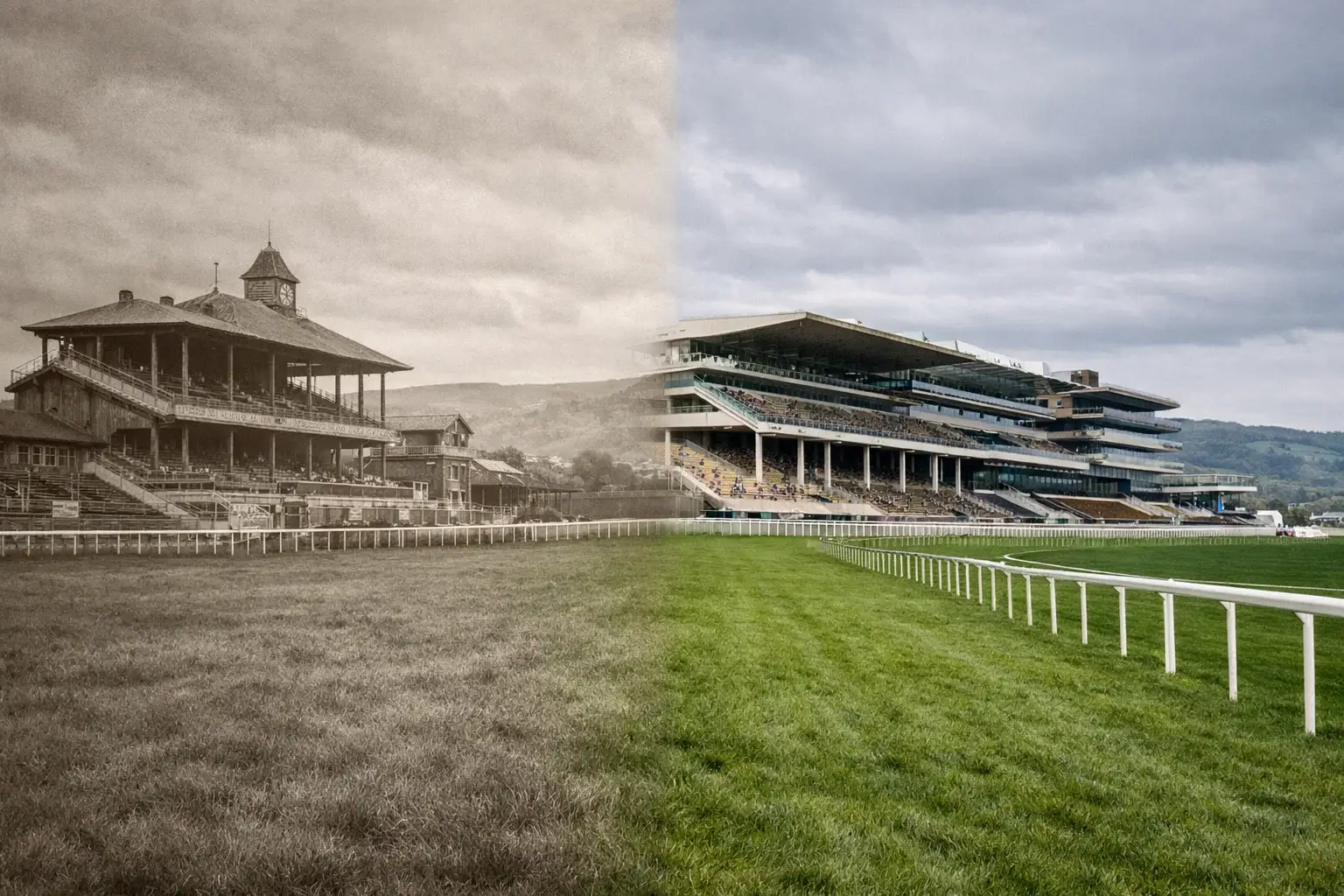
Cheltenham Festival History: From a Single Race to the Biggest Week in Jump Racing
Every great bet at Cheltenham echoes a century of stories. The festival as it exists today — four days, twenty-eight races, a quarter of a million spectators, hundreds of millions in bets — is the product of a history that stretches back to the middle of the nineteenth century. What began as a modest steeplechase meeting on the hills above Cheltenham has evolved into the most important week in National Hunt racing, a fixture that defines careers, breaks hearts and produces moments that resonate through the sport for decades. The wider context is set out in our Cheltenham betting guide.
Understanding that history is not mere nostalgia. It explains why the festival matters, why the crowd generates its unique atmosphere, and why certain races carry a weight that goes beyond the prize money on offer. The Champion Hurdle, the Gold Cup, the Arkle — these names are not arbitrary labels. They are memorials to horses and eras that shaped the sport, and the punter who knows their history understands the festival at a level that no form guide can provide.
Origins: The 1860s, Prestbury Park and the Growth of National Hunt
Racing at Cheltenham dates to the early nineteenth century, but the modern festival traces its lineage to the establishment of the National Hunt Chase in the 1860s. The event moved between various locations in the Cheltenham area before finding a permanent home at Prestbury Park, the site that still hosts the festival today. The racecourse sits in a natural amphitheatre at the foot of Cleeve Hill, and its topography — the famous uphill finish, the undulations that test stamina and jumping ability — has been central to its character from the beginning.
The Cheltenham Gold Cup was first run in 1924, and the Champion Hurdle followed in 1927. These two races became the pillars around which the festival was built. The Gold Cup, as the supreme test of the staying steeplechaser, attracted the best horses from both sides of the Irish Sea, while the Champion Hurdle established the two-mile hurdling championship as a fixture of equal prestige. Together, they gave the festival a twin identity: endurance and speed, power and finesse.
Through the mid-twentieth century, the festival grew in stature but remained a relatively intimate affair by modern standards. It was a three-day meeting, attended primarily by the racing community itself — trainers, owners, breeders, professional punters and the dedicated amateurs who followed National Hunt racing through the winter months. The crowds were measured in thousands, not tens of thousands, and the betting market was confined to the on-course ring and high-street shops. The festival had prestige, but it had not yet become the mass spectacle it would later become.
The post-war period saw the establishment of several races that would become festival staples: the Stayers’ Hurdle, the Arkle Challenge Trophy, the Supreme Novices’ Hurdle and various handicaps that gave the card depth beyond the championship races. Each addition increased the festival’s appeal to punters, because each additional race represented another betting opportunity and another avenue for trainers to target with their stable stars.
Legendary Horses: Arkle, Golden Miller, Best Mate and Istabraq
The festival’s history is written in the names of its greatest horses, and no name looms larger than Arkle. The Irish-trained steeplechaser won the Gold Cup three times in succession from 1964 to 1966, demolishing fields with a superiority so complete that the handicapper was eventually forced to create separate weight bands for races in which he competed. Arkle was not merely the best horse of his generation; he was, by many assessments, the best National Hunt horse ever to race. The race that now bears his name — the Arkle Challenge Trophy — was created in tribute, and it remains one of the most prestigious novice chases on the programme.
Before Arkle, Golden Miller set the Gold Cup standard with five consecutive victories from 1932 to 1936, a record that has never been matched. Golden Miller also won the Grand National in the same year as one of his Gold Cups, a feat so demanding that no horse has come close to repeating it. His dominance established the Gold Cup as the race that defined jump racing’s ultimate champion, a status it has retained ever since.
Best Mate provided the modern era’s closest echo of Golden Miller, winning three consecutive Gold Cups from 2002 to 2004. Trained by Henrietta Knight, Best Mate became a national celebrity — a horse whose name was known far beyond the racing community. His three victories coincided with a period of rising public interest in the festival, and his death from a heart attack during a race at Exeter in 2005 generated national mourning. Best Mate’s era marked the moment when the Gold Cup became a mainstream sporting event, not just a racing one.
Istabraq, trained by Aidan O’Brien, won three consecutive Champion Hurdles from 1998 to 2000 and would almost certainly have won a fourth had the 2001 festival not been cancelled due to the foot-and-mouth disease crisis. His brilliance over two miles was the hurdling equivalent of Arkle’s dominance over fences — a horse so far ahead of his contemporaries that the result often felt like a formality. The Champion Hurdle’s reputation as the race where class prevails owes much to Istabraq’s era.
The Modern Era: Expansion to Four Days, Irish Dominance and Record Crowds
The most significant structural change in the festival’s modern history was the expansion from three days to four in 2005. The additional day created seven new races, increased the overall prize fund substantially, and transformed the festival from a concentrated three-day affair into a week-long event that became one of the major fixtures in the British sporting calendar. The four-day format attracted new audiences, increased media coverage, and turned the festival into a social event as much as a sporting one.
Attendance surged in the years following the expansion. The four-day format peaked in 2022, when a record 280,627 people attended across the four days, as reported by the Irish Times. That record reflected the pent-up demand following the covid-era restrictions and established Cheltenham as one of the largest annual sporting gatherings in Britain. The economic impact of the 2022 festival was estimated at £274 million for the local economy, according to a Jockey Club study, underscoring how the expansion from three to four days had amplified the festival’s economic significance.
The modern era has also been defined by the rise of Irish dominance. From the mid-2010s onwards, Irish-trained runners have won the majority of festival races, led by Willie Mullins and Gordon Elliott. The Prestbury Cup — the annual competition between Irish and British-trained runners — has been won by Ireland in every year since 2016, often by wide margins. This shift has reshaped the betting landscape, making the nationality of the trainer a meaningful factor in selection decisions. The lighter side is collected in the fun facts.
The festival continues to evolve. Capacity caps, changing ground conditions influenced by climate patterns, and a regulatory environment that is reshaping the betting industry all contribute to a festival that looks different each year. But the core identity remains what it has been since the 1860s: the ultimate test of horse, jockey and trainer over the Cheltenham hills, and the ultimate challenge for the punter who believes they can read the data and beat the market.
