
 Available in US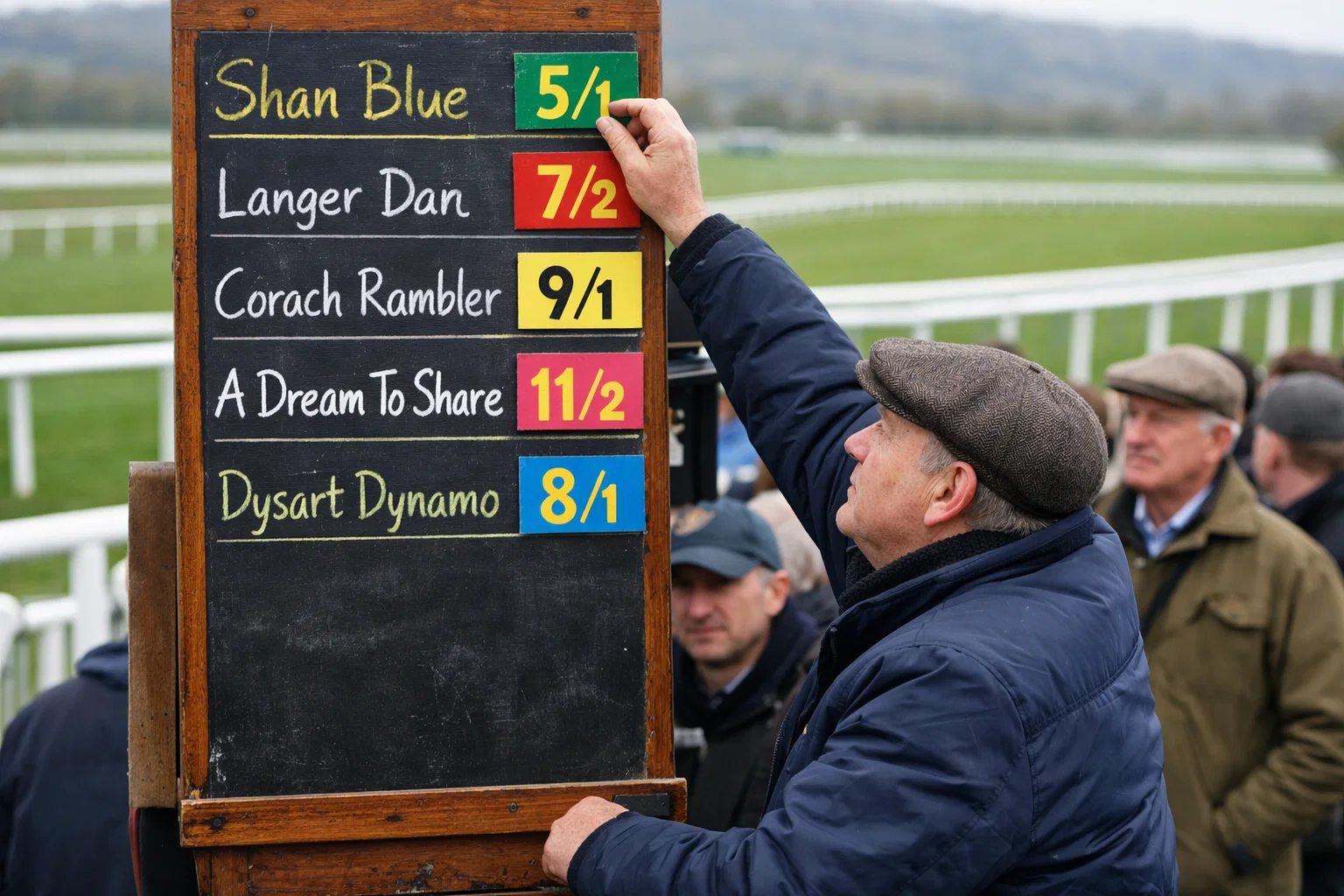
Cheltenham Market Movers: What Line Movement Tells You That the Racecard Cannot
The racecard tells you what a horse has done. The market tells you what people who stake real money believe a horse will do. Both are useful; neither is sufficient alone. At Cheltenham, where the gap between public perception and actual probability creates some of the most mispriced races of the year, reading the market’s movement is a skill that separates punters who react from punters who anticipate. The market moves before the race — your edge is reading why. The wider context is set out in our Cheltenham betting guide.
Market movers at Cheltenham are not random noise. When a horse shortens from 10/1 to 6/1 in the space of an hour, money is arriving for a reason. That reason might be a positive report from the gallops, a jockey booking that signals stable confidence, a going change that suits the horse, or simply a wave of public money following a newspaper tip. The punter who can distinguish between these causes — informed money versus herd behaviour — has an advantage that no amount of form study can replicate.
This guide explains why odds move, how to interpret the two main types of movement (steamers and drifters), and how to build a simple framework for deciding whether a market mover represents genuine value or a trap.
Why Odds Move: Money, Information and Market Mechanics
Bookmaker odds are not fixed predictions — they are prices in a market, and like any market price, they respond to supply and demand. When money arrives for a particular horse, the bookmaker shortens its odds to reduce their liability and lengthens the odds on other runners to rebalance the book. The more money that comes for a horse, the more its price contracts. The process is continuous, running from the moment the market opens until the race goes off.
At Cheltenham, this process operates at an intensity that dwarfs a typical Saturday afternoon at Ascot or Haydock. William Hill projected that approximately £450 million in bets would be placed across Britain during the 2026 festival, according to a Reuters report. That volume of liquidity means that prices can shift rapidly and dramatically. A horse that opens at 12/1 in the morning can be 7/1 by the time the runners enter the parade ring, and 5/1 by the off. Each contraction reflects money arriving, and the speed of the contraction reflects how much money and how quickly.
The sources of that money are not homogeneous. Professional punters, who bet in large amounts and are often among the earliest to act, tend to move prices efficiently — their bets are based on private information or superior form analysis. Public money, which arrives later and in smaller individual amounts but higher aggregate volume, tends to follow visible signals: a newspaper tip, a television pundit’s selection, or simply the recognition of a famous horse’s name. Distinguishing between the two is the core skill of market reading.
A third source of price movement is bookmaker-driven. Bookmakers sometimes shorten a horse’s odds not because money has arrived but because they want to attract bets on other runners in the race. This “laying off” strategy is more common in big-field handicaps where the bookmaker’s liabilities are spread across many runners. Recognising when a price move is bookmaker-generated rather than punter-generated is difficult but not impossible — it tends to happen uniformly across multiple bookmakers simultaneously, rather than originating with one firm and spreading.
Steamers and Drifters: Reading the Signals at Cheltenham
A steamer is a horse whose price shortens significantly in the lead-up to a race. A drifter is one whose price lengthens. At Cheltenham, both carry information, but the quality of that information varies enormously.
Steamers are the more immediately exciting signal. A horse that contracts from 14/1 to 8/1 has attracted substantial backing, and the natural instinct is to follow the money. But not all steamers are equal. A horse that shortens because a respected racing operation has placed large bets through professional channels is a qualitatively different steamer from one that shortens because a tabloid front-page tip has sent thousands of casual punters to their apps. The first type of steamer is driven by information; the second is driven by volume. Both move the price, but only the first type reliably indicates that the horse’s true chance is better than the market originally assessed.
In 2025, favourites won only nine of twenty-eight festival races, as William Hill reported. Many of those favourites were steamers that attracted heavy public support yet still lost. The lesson is clear: following the crowd into a steamer without understanding why the price has moved is not a strategy — it is a reflex. Dan Skelton captured the competitive dynamic at the festival when he acknowledged that “the reality is Willie will be leading trainer. With a bit of luck, we might be pitching behind him along with a few others.” The market prices that reality correctly: Mullins’ runners often steam because the money recognises the stable’s power. But when a horse from a less dominant yard steams on the morning of the race, the signal is worth investigating more closely — it may reflect insider confidence that the public has not yet processed.
Drifters are often more useful than steamers, counterintuitively. When a fancied horse’s price lengthens from 5/1 to 8/1, the market is telling you that confidence is ebbing. The reasons might be negative: a poor report from the racecourse, a going change that does not suit the horse, or a jockey switch that signals concern. They might also be mechanical: money arriving for a rival has pushed the other prices out. Distinguishing between a genuine negative drift and a mechanical one is where the betting exchange offers an advantage. On the exchange, you can see the actual volume of money traded at each price — if the horse’s price is drifting on the exchange with no significant bets placed against it, the drift is likely mechanical rather than informed.
A Simple Value Framework: Implied Probability vs Your Assessment
Every set of odds implies a probability. A horse at 4/1 carries an implied probability of 20%. A horse at 9/1 implies approximately 10%. The market’s assessment of every runner in a race, when combined, will sum to more than 100% — the excess is the bookmaker’s overround, or margin. Your job as a value bettor is to find horses where your assessed probability is higher than the implied probability of the available odds.
The framework is deliberately simple. Before the race, assess each runner you are interested in on a rough percentage scale. If you think a horse has a 25% chance of winning and it is available at 5/1 (implied 16.7%), the odds are offering more than the horse’s true chance warrants — that is value. If the same horse is 3/1 (implied 25%), the price is fair but not generous. If it is 2/1 (implied 33%), the market is overestimating the horse and you should look elsewhere.
Market movers feed directly into this framework. When a horse steams from 8/1 to 5/1, the implied probability has shifted from 11% to 16.7%. If your pre-movement assessment of the horse’s chance was 15%, the 8/1 was value and the 5/1 is not. The steamer has moved the price through your value threshold, and the correct response is to let it go — even though the market is telling you the horse is more fancied than before. Following a steamer beyond your value point is paying more than the horse is worth to you, regardless of what other punters are doing.
Conversely, a drifter that moves from 6/1 to 10/1 might cross into value territory for you. If your assessment says the horse has a 12% chance and the 10/1 price implies 9.1%, the drift has created an opportunity that did not exist at the shorter price. This is the contrarian edge that market movers create: the crowd moves in one direction, and the punter with a pre-existing assessment benefits from the opposite movement. Early prices behave differently: ante-post betting.
The framework requires discipline. It forces you to form an opinion before you look at the market, not after. If you check the odds first and then decide whether you agree, you are anchoring your assessment to the market’s view and losing the independence that makes value betting work. Do your form analysis, assign your probabilities, then check the market. If the price exceeds your threshold, bet. If it does not, move on. The market movers will come and go — your framework stays constant.
