
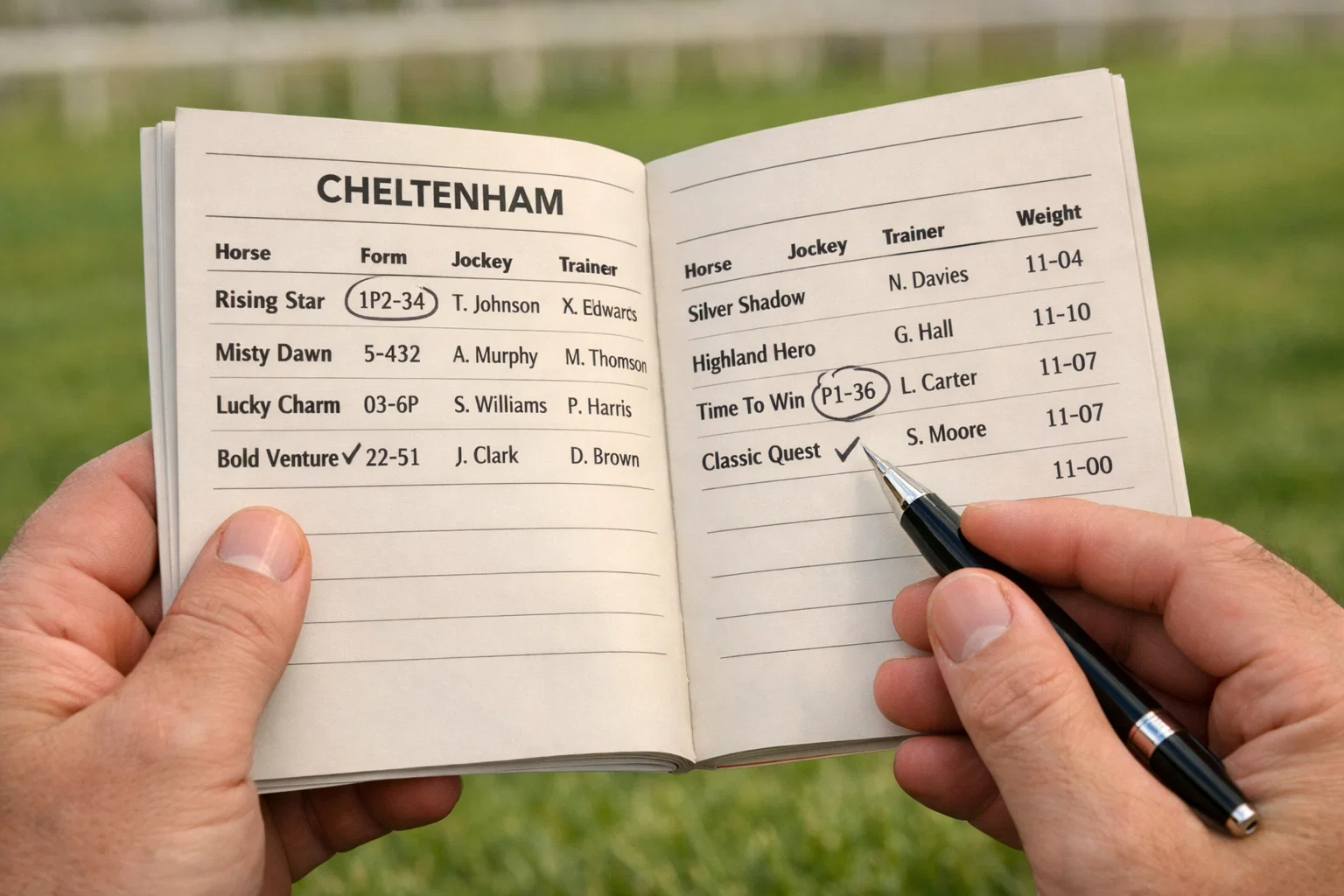
Reading a Cheltenham Racecard: The Skill That Separates Informed Bets from Guesses
The racecard is the betting cheat sheet most punters ignore. It sits right there — in the newspaper, on the app, printed in the official programme — packed with data that can sharpen your selections or stop you backing a horse with no realistic chance. Yet the majority of Cheltenham bettors glance at the card, note the horse’s name and the jockey, check the odds, and move on. The numbers, abbreviations and symbols go unread, and the edge they offer goes unclaimed.
A Cheltenham racecard is denser than a typical midweek card at a regional track. Festival races attract high-quality fields with deep form profiles, which means the card contains more information per runner and more comparative data points to work with. Knowing how to extract that information is not a specialist skill — it takes about ten minutes to learn the basics — but applying it consistently over the course of the festival is what separates the punter who bets with evidence from the one who bets on instinct.
This guide walks through the anatomy of a standard UK racecard, explains the form figures that confuse newcomers, and shows how to convert racecard data into a practical betting decision.
Anatomy of a Racecard: What Every Column Means
A standard UK racecard contains the following elements for each runner, though the layout varies between publications and apps. Knowing what each field represents is the first step.
The cloth number is the large number assigned to each horse for identification. It corresponds to the number on the saddlecloth the horse wears during the race. At Cheltenham, where races can feature large fields, the cloth number is how you track your selection through binoculars or on the screen.
Next to the number, you will usually find the draw position, but this is only relevant for flat races. In National Hunt racing at Cheltenham, there is no draw — horses line up across the width of the track — so you can ignore this column entirely if it appears.
The horse’s name is followed by its age and the weight it carries. In handicap races, the weight is critical: it reflects the handicapper’s assessment of each horse’s ability. A horse carrying 11 stone 12 pounds is rated higher than one carrying 10 stone 2 pounds. In non-handicap races, the weight is determined by the conditions of the race (usually age and sex allowances) rather than an individual rating. The weight tells you how the race is structured but not necessarily who will win.
The trainer and jockey columns identify who prepares the horse and who rides it. At Cheltenham, both matter enormously. Certain trainers have exceptional festival records, and the jockey booking can signal confidence — a top jockey choosing one ride over another in the same race often indicates which horse the stable believes has the better chance.
The official rating (OR) appears in handicap races and represents the horse’s assessed ability on a numerical scale set by the BHA handicapper. Higher numbers indicate better horses. Comparing the OR with the horse’s current form gives you a snapshot of whether the horse is likely to be well handicapped (improving and potentially ahead of its mark) or poorly handicapped (declining and carrying too much weight).
Finally, the form figures — a string of numbers, letters and symbols to the left of the horse’s name — compress the horse’s recent racing history into a compact code. These figures are the most information-dense element on the card and deserve their own section.
Decoding Form Figures: What 1-2P3F0 Actually Tells You
Form figures read from left to right, with the most recent result on the right. Each number represents the horse’s finishing position in its last few races: 1 means a win, 2 means second, and so on up to 9. A 0 means the horse finished tenth or worse. A dash (-) separates the current season from the previous one, so you can see at a glance how recent the form is.
The letters embedded in the form string carry additional meaning. F stands for fell — the horse came down during the race. P means pulled up, which indicates the jockey stopped riding, usually because the horse was exhausted, injured or hopelessly beaten. U means unseated rider, where the horse made a jumping error that dislodged the jockey. R means refused — the horse stopped at a fence or hurdle and declined to jump. Each of these letters signals a disruption, and they are worth noting carefully. A horse with F in its recent form has a jumping question to answer. A horse with P might have been stopping through exhaustion or might have been pulled up to protect it from injury — the context matters.
At Cheltenham, where the fences are stiff and the hill punishes tired horses, form figures containing F or P are particularly relevant. A horse that has fallen at a similar track in its last two runs is a higher-risk proposition than one showing a clean sequence of placed finishes. Conversely, a horse showing 1-1 at the end of its form string is one that has won its last two races — a powerful signal of current wellbeing and confidence.
Age data, while not in the form figures themselves, is visible on the racecard and worth cross-referencing. Seven-year-olds with previous festival wins have a 28% strike rate in subsequent festival appearances, according to OLBG. When you see a seven-year-old with strong form figures and a festival win in its recent history, that convergence of data points is exactly what the racecard is designed to reveal.
From Racecard to Bet: A Practical Walkthrough
Suppose you are looking at the racecard for a handicap hurdle at Cheltenham with sixteen runners. You want to narrow the field to three or four serious contenders before checking the odds. Here is how racecard data gets you there.
Start with age. OLBG data shows that horses five or more years older than the youngest runner in a race have managed just 14 wins from 264 festival races since 2003. That is a brutal filter. If the youngest horse in the race is six and your fancy is twelve, the data says to move on. Eliminate any runner whose age profile puts them on the wrong side of this trend, and the field immediately shrinks.
Next, read the form figures. Discard any horse showing multiple Fs or Ps in its recent sequence — these are horses with unresolved jumping or stamina questions. Look for runners showing 1s and 2s in their most recent starts, particularly if those runs came at a similar level of competition. A horse that has won a Class 2 handicap hurdle at Haydock and then finished second in a Grade 3 at Cheltenham’s January meeting is a different prospect from one that has been plodding around Class 4 events at regional tracks.
Check the trainer column. The dominance of Irish-trained horses at the festival is not a coincidence — it reflects a systematic approach to horse recruitment and preparation. RTÉ racing analyst Jane Mangan has observed that “Ireland has been recruiting the best horses for the last five, six or seven years, and the results have motivated those trainers in the UK to change their purchasing strategies.” When you see an Irish trainer’s name on the racecard, particularly from one of the major yards, that runner deserves an extra look regardless of its odds.
Finally, cross-reference the official rating with the weight carried. A horse with an OR of 145 carrying 11 stone 4 in a handicap is racing off its correct mark. But if that horse has won since that rating was published, it may be effectively “ahead” of the handicapper — well in at the weights. These are the horses that the racecard reveals to the attentive reader and hides from the casual one.
The entire process takes five to ten minutes per race. It will not guarantee a winner, but it will guarantee that every bet you place is supported by evidence rather than guesswork. At a festival as competitive as Cheltenham, that is worth more than any tip.