
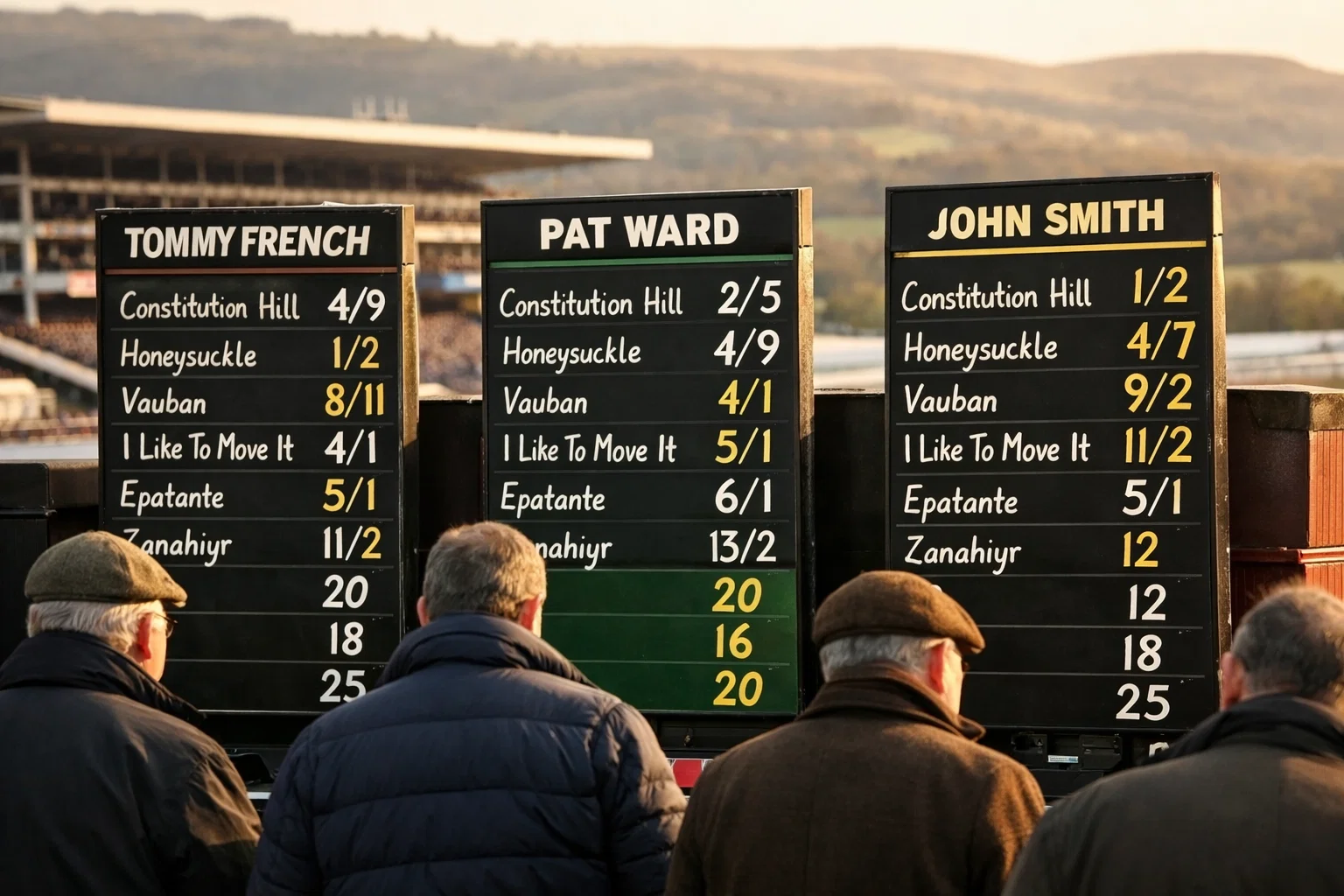
- Why Cheltenham Odds Vary — and What That Means for Your Return
- How Cheltenham Odds Are Set and Why They Move
- Comparing Odds: What to Check Beyond the Headline Price
- Today's Odds Snapshot Across Key Races
- Best Odds Guaranteed: How It Tilts the Maths in Your Favour
- Reading Line Movement: Shorteners, Drifters and Market Signals
Why Cheltenham Odds Vary — and What That Means for Your Return
Cheltenham odds comparison is one of those subjects that sounds tedious until you realise how much money it leaves on the table. Take a hypothetical favourite in the Champion Hurdle, priced at 2/1 with one bookmaker and 9/4 with another. A £50 win bet returns £150 in the first case and £162.50 in the second. Same horse, same race, same outcome — twelve pounds and fifty pence difference. Multiply that across a four-day Festival with twenty-eight races, and you begin to understand why serious punters never bet with a single firm.
The price discrepancies at Cheltenham are not accidental. They emerge from structural differences in how bookmakers construct their markets, how they manage liability, and how aggressively they compete for your custom during the biggest week in National Hunt racing. Some operators sharpen prices on favourites to attract volume, accepting a thinner margin on the headline runners while building profit into the outsiders. Others take the opposite approach, offering best prices on longer shots while keeping the favourite slightly mean. Neither model is inherently better or worse — what matters is that you know which firm offers the best price on the specific horse you want to back, in the specific race, at the specific time.
This guide breaks down how Cheltenham odds are formed, what moves them, and which factors beyond the headline price — place terms, Best Odds Guaranteed, Rule 4 deductions — should influence where you place your money. The best price is never in one place, and the Festival is the week where that principle matters most.
How Cheltenham Odds Are Set and Why They Move
Before you can compare prices intelligently, it helps to understand where those prices come from. Bookmakers don’t pluck numbers from the air. They start with a tissue price — an internal estimate of each horse’s probability of winning, derived from form analysis, going reports, market intelligence, and increasingly, algorithmic models. The tissue is the skeleton. What the public sees is the tissue adjusted for margin.
That margin is the overround. In a perfectly fair market, the implied probabilities of all runners in a race would sum to 100%. In practice, bookmakers build in an overround that typically sits between 110% and 130%, depending on the competitiveness of the market and the size of the field. The bigger the overround, the worse the value for the punter. During Cheltenham week, competitive pressure between firms tends to compress overrounds on the marquee races — the Gold Cup, the Champion Hurdle, the Champion Chase — because these are the events that generate the most public interest. Bookmakers accept slimmer margins on these races to attract customers, hoping to recoup on the less-followed handicaps where overrounds stay fatter.
Understanding this dynamic helps explain why odds comparison has its greatest impact in certain types of race. In a small-field Grade 1 with a strong favourite, the prices across bookmakers tend to cluster tightly. The Champion Hurdle favourite might be 2/1 everywhere, with only the occasional 9/4 breaking ranks. But in a 20-runner handicap, the spread between the best and worst price on any given runner can be substantial — sometimes two or three points of odds — because each bookmaker’s tissue assigns slightly different probabilities and their liability management differs.
The scale of the betting market amplifies these differences. William Hill has projected that punters across Britain will wager approximately £450 million on Cheltenham 2026. That volume of money flowing through multiple operators creates a liquid market where prices adjust rapidly. When a wave of money lands on a horse at one bookmaker, that firm shortens the price — but other firms may lag behind by minutes or even hours, creating temporary windows where the same horse is available at a significantly better price elsewhere.
The broader industry context matters too. Online horse racing generated £766.7 million in gross gaming yield in the UK during financial year 2024-25, according to the Gambling Commission. Horse racing remains the second-largest betting sport in Britain, and Cheltenham week accounts for a disproportionate share of that activity. The sheer concentration of money into four days of racing means that odds are more dynamic — and more variable between operators — than at any other point in the National Hunt calendar. Maarten Haijer, Secretary General of the European Gaming and Betting Association, has noted the broader shift in the industry: “While land-based gambling remains dominant, online channels are showing stronger momentum, driven by changing consumer preferences and technological advancement,” according to the EGBA’s 2025 market report. That migration online is precisely what makes price comparison so practical — you can check six bookmakers in the time it used to take to visit one betting shop.
Comparing Odds: What to Check Beyond the Headline Price
The headline price — the number next to the horse’s name — is only part of the equation. Several factors can make an apparently identical price materially different in practice, and ignoring them is a reliable way to leave money behind.
Start with place terms. For each way bets, the place fraction and the number of places paid vary between bookmakers and between races. Standard Festival terms for handicaps with 16 or more runners are typically one-quarter the odds for the first four places. But during Cheltenham week, several firms offer enhanced place terms — paying five or even six places on selected races — as a promotional tool. If you’re betting each way on a 14/1 shot in a big-field handicap, the difference between getting paid for the first four and the first five is the difference between collecting and tearing up your slip if the horse finishes fifth. Always check place terms before placing an each way bet, not after.
Next, consider Best Odds Guaranteed. This feature, offered by most major UK bookmakers for horse racing, guarantees that if you take a price and the starting price is higher, you get paid at the better price. BOG effectively removes the timing risk from early prices — you take 5/1 in the morning, the horse drifts to 7/1 by the off, and you get paid at 7/1. The value of BOG is asymmetric: it protects you if the price drifts but doesn’t penalise you if it shortens. Not every bookmaker applies BOG to Festival races, and some exclude certain promotional markets. It is worth confirming the policy before the first race, because it fundamentally changes the optimal betting time. With BOG, there is essentially no downside to taking early prices, which is why it features later in this guide as a standalone section.
Rule 4 deductions are the less glamorous sibling of odds comparison, but they matter. When a horse is withdrawn from a race after the market has formed, the remaining runners’ odds are adjusted downward through a Rule 4 deduction to reflect the absent runner’s removal. The deduction is applied to your potential winnings and can range from a few pence in the pound to as much as 75p for a short-priced withdrawal. In practical terms, a Rule 4 deduction can turn a profitable bet into a marginal one. If you’ve backed a horse at 4/1 and a rival is withdrawn with a 25p Rule 4, your effective odds drop to 3/1. There’s nothing you can do about non-runners after the fact, but being aware of the mechanism means you can factor withdrawal risk into your timing decisions, particularly in races where a fragile favourite might not make it to the start.
Finally, dead heats. They don’t happen often at Cheltenham, but when they do, your winnings are halved. A dead heat on a 10/1 winner returns only half the expected payout. Dead heats are more common in tight finishes on the flat, but they can and do occur over jumps, particularly in photo finishes on the run-in. No comparison tool accounts for dead heats in advance — it’s simply worth knowing the rule so that a reduced payout doesn’t come as a bewildering surprise on what should have been a celebration.
Today’s Odds Snapshot Across Key Races
Prices shift by the hour on Festival morning, so what follows is a snapshot of the market landscape at the time of writing rather than a fixed reference. The purpose isn’t to tell you which firm is cheapest on every runner — that changes constantly — but to illustrate the kind of variation that exists and where comparison pays the biggest dividend.
In the Supreme Novices’ Hurdle, the market favourite is trading around 3/1 with most major operators, but there’s a meaningful split between firms offering 3/1 and those pushing 10/3. On a £25 bet, that’s the difference between a return of £100 and £108.33 — not life-changing on a single bet, but indicative of the broader pattern. The second favourite shows a wider spread: 5/1 in some places and 6/1 in others, a full point of odds that represents genuine value leakage if you’re not looking.
The Champion Hurdle market is, predictably, the tightest of the day. The likely favourite sits between 2/1 and 9/4 across the board, with only marginal variation. This is the race where bookmakers compete most aggressively on price because it attracts the most bets. Since 2000, the favourite has won the Champion Hurdle 52% of the time — the highest conversion rate of any Festival race, based on data from Betway’s historical analysis. That statistical tendency drives enormous volume on the favourite, and bookmakers know they need a competitive headline price to capture their share of that action. For the punter, this means the marginal gain from comparison in the Champion Hurdle is smaller than in other races. A quarter-point here, an eighth there — useful, but not transformative.
The Festival Handicap Hurdle is where the real disparity emerges. In a 20-runner field, the range of prices on a mid-market contender can stretch from 10/1 to 14/1 depending on the operator. That’s not a marginal difference — it’s a 40% variation in potential return on the exact same horse in the exact same race. The reason is liability management. One bookmaker may have taken a large bet on a specific runner early in the morning, prompting them to cut the price aggressively, while another firm with no significant exposure on that horse still offers the wider price. These windows of opportunity are temporary but frequent during Cheltenham week, and they appear most reliably in the handicaps.
The Arkle and the Bumper sit somewhere in between. Both feature fields of moderate size where the favourite tends to trade within a half-point spread across firms. Comparison still matters in these races, but the gains are incremental rather than dramatic. The principle remains the same: check at least three or four firms before committing, note the best price, and place the bet there. It takes ninety seconds and it compounds across twenty-eight races over four days.
One pattern worth noting is that early morning prices are typically more variable than afternoon prices. As the market matures and more money flows in, bookmakers tend to converge on a consensus price. If you do your comparison in the morning — say, between 8am and 10am — the spreads between firms will be wider than they are an hour before the off. This isn’t universally true, but it holds often enough to inform your timing. Combine early comparison with Best Odds Guaranteed, and you capture the widest possible spread with a built-in safety net if the price subsequently drifts.
Best Odds Guaranteed: How It Tilts the Maths in Your Favour
Best Odds Guaranteed — usually abbreviated to BOG — is the single most punter-friendly feature in UK horse racing betting, and it’s especially valuable during the Festival. The principle is simple: you take a price at any point before the race, and if the starting price is higher, you get paid at the starting price instead. If the starting price is lower, you keep your original price. It is, in effect, a free option on upside.
Consider a practical example. You back a horse at 6/1 in the morning. By the time the race goes off, the horse has drifted to 8/1 — maybe a more fancied rival has been withdrawn, or the market has reassessed the field. With BOG, your £20 bet returns £180 (8/1 × £20 plus your stake) instead of the £140 you would have received at your original price. That’s a £40 difference on a single bet without any additional risk.
Now reverse the scenario. You take 6/1 in the morning, heavy money comes in during the afternoon, and the horse goes off at 4/1. Without BOG, you’d still get your 6/1 because you locked in the price. With BOG, the outcome is identical — you still get 6/1. The guarantee only operates in one direction: it enhances your return when the SP is higher, and it doesn’t reduce it when the SP is lower. This asymmetry is the key to understanding why BOG fundamentally changes when you should bet.
Without BOG, there is a genuine timing dilemma. Take the price early and risk it drifting (leaving profit on the table), or wait until closer to the off and risk it shortening (meaning you get a worse price). BOG eliminates the first half of that dilemma. With it active, the only risk of betting early is that the price shortens — but you’ve already locked in the current price, so the shortening costs you nothing. The optimal strategy under BOG is therefore to take the price whenever your analysis tells you the horse represents value, regardless of how far in advance of the race you make the decision. There’s no reason to wait.
A few caveats. Not all bookmakers offer BOG on all Cheltenham races. Some exclude ante-post bets taken more than 24 hours before the race. Others limit BOG to specific bet types — win only, not each way, for instance. A handful apply a cap on the SP enhancement, meaning that if the starting price drifts to 33/1 on a horse you backed at 10/1, they’ll pay out at a maximum of, say, 20/1 rather than the full SP. These restrictions vary by firm and by promotion, so reading the terms before relying on BOG is essential. It’s not complicated — it just requires one check per bookmaker at the start of the Festival rather than per race.
Reading Line Movement: Shorteners, Drifters and Market Signals
BOG protects you against price movement — but understanding why prices move in the first place gives you an advantage that no bookmaker feature can replicate. Odds move because money moves, and money moves for reasons. Learning to distinguish between meaningful line movement and noise is one of the most useful skills a Cheltenham punter can develop. It won’t make you right every time — nothing does — but it adds a layer of information that pure form analysis misses.
A shortener, or steamer, is a horse whose price contracts in the hours or minutes before a race. If a horse opens at 10/1 in the morning and goes off at 6/1, it has been steamed. The conventional wisdom is that steamers carry “insider” information — perhaps the trainer has reported the horse in exceptional form, or a well-connected punter has placed a large bet. There is some truth to this at the extremes. A horse that halves in price in the final twenty minutes of trading has almost certainly attracted significant informed money. But smaller moves — a drift from 8/1 to 7/1, say — can be driven by herd behaviour, media coverage, or simply one bookmaker adjusting their book after a lopsided wave of bets. Not every shortener deserves the reverence punters give it.
Drifters — horses whose price lengthens — are often more informative. When a horse that was expected to go off short in the market instead drifts from 5/2 to 4/1, it typically signals one of three things: negative news about the horse’s well-being or preparation, a track condition the horse is known to struggle with, or the emergence of a stronger rival in the market. At Cheltenham, the going is the most frequent driver of drift. A horse whose connections wanted good ground but are facing good to soft will often drift as informed money moves elsewhere. That drift is actionable information.
Last year’s Festival provided a useful illustration. In 2025, the starting favourites won 9 of 28 races — a 32.1% strike rate, slightly below the long-term average, as reported by William Hill. Several of those losing favourites showed notable market drift in the final hour of trading. They went off at shorter prices than they would have without the weight of public money, but the smart money had already moved on. The lesson: when informed money exits a horse and casual money fills the gap, the price looks stable but the underlying probability has shifted. Reading the direction and speed of movement — not just the final price — is what matters.
For today’s card, the races to watch most closely for line movement are the handicaps. In small-field Grade 1s, the top two or three in the market tend to absorb most of the money, and price movements are gradual. In a 20-runner handicap, a single large bet can move a horse by two or three points in minutes. These violent moves create the biggest comparison opportunities — the price at one bookmaker may not yet have adjusted to reflect the move at another, giving you a window to act.
One final thought: line movement is information, not instruction. A horse that shortens might win, but it might also simply be the subject of a poorly judged punt. A drifter might go on to win at a bigger price than anyone expected. The market is a useful input, not an oracle. Treat it as one signal among several — form, going, trainer, course history — and you’ll avoid the trap of simply following money rather than following evidence. The best price is never in one place, and the best reading of the market requires looking at the whole picture rather than a single number on a screen.